Estimated reading time:10 minutes, 28 seconds
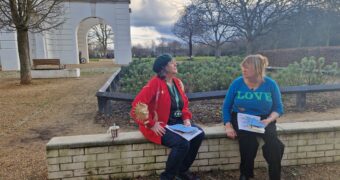
Everyone has a story. Demolition, campaigns to bring in pedestrian crossings and a street party offering anaconda kebabs – this is just a fraction of the community building around the streets of Finsbury Park that you can discover by looking through old copies of the ‘Finsbury Parker’ newsletter. Report by Nicola Baird with help from Dorothy Newton.
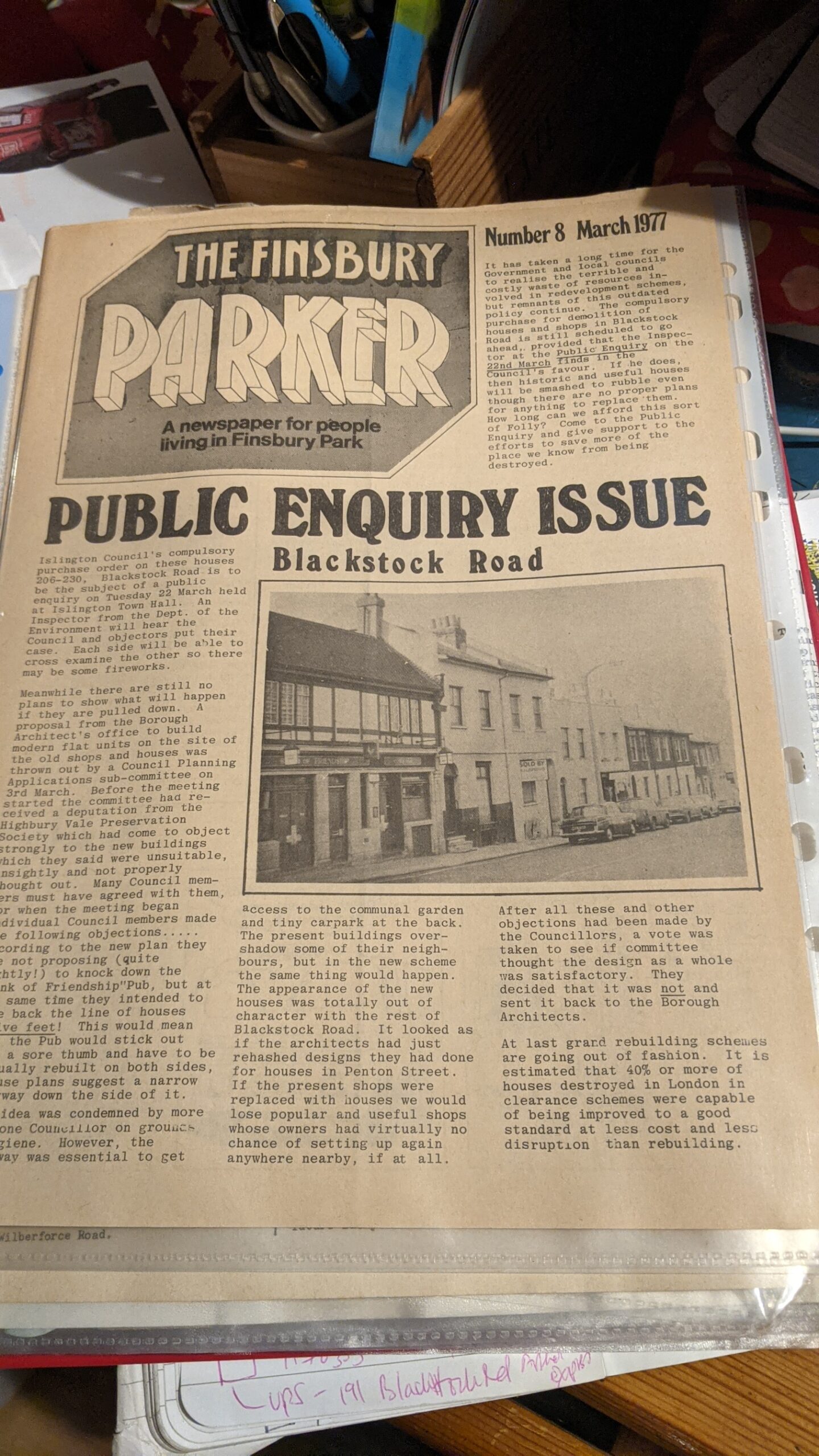
March 1977 from the Finsbury Parker (c) NB for Islington Faces
Islington Faces has been lent a folder of the Finsbury Parker created by Finsbury Park Community Group from our friend Dorothy Newton who has been hugely involved in this community since the 1970s. It’s fascinating looking back at the main campaigns which those determined Finsbury Parkers raised, won and lost.
The collection we’ve seen isn’t complete, but starts as a typed newsletter in June 1975 and ends as a DTP designed magazine in Spring 2001. At every stage it is a small group of community activists trying to convince the councils, but particularly Islington and Hackney, to take better care of the area. Dorothy says: “Finsbury Park covers three boroughs but our campaigns in the 1970s onwards were always about Islington and Hackney. The actual park was run by the GLC then, Haringey manages it now.”
FOLLOW Islington Faces, a new interview is published approx once a fortnight.
Here we share a handful of extracts from the Finsbury Parker billed as “a newspaper for people living in Finsbury Park” neighbourhood.
Dorothy says: “The Finsbury Parker was such a group effort. We wrote it together. It was then printed and taken to one person who parcelled them up, then everyone collected a bundle and delivered them door to door. We all delivered them in our own streets around Islington and Hackney.”
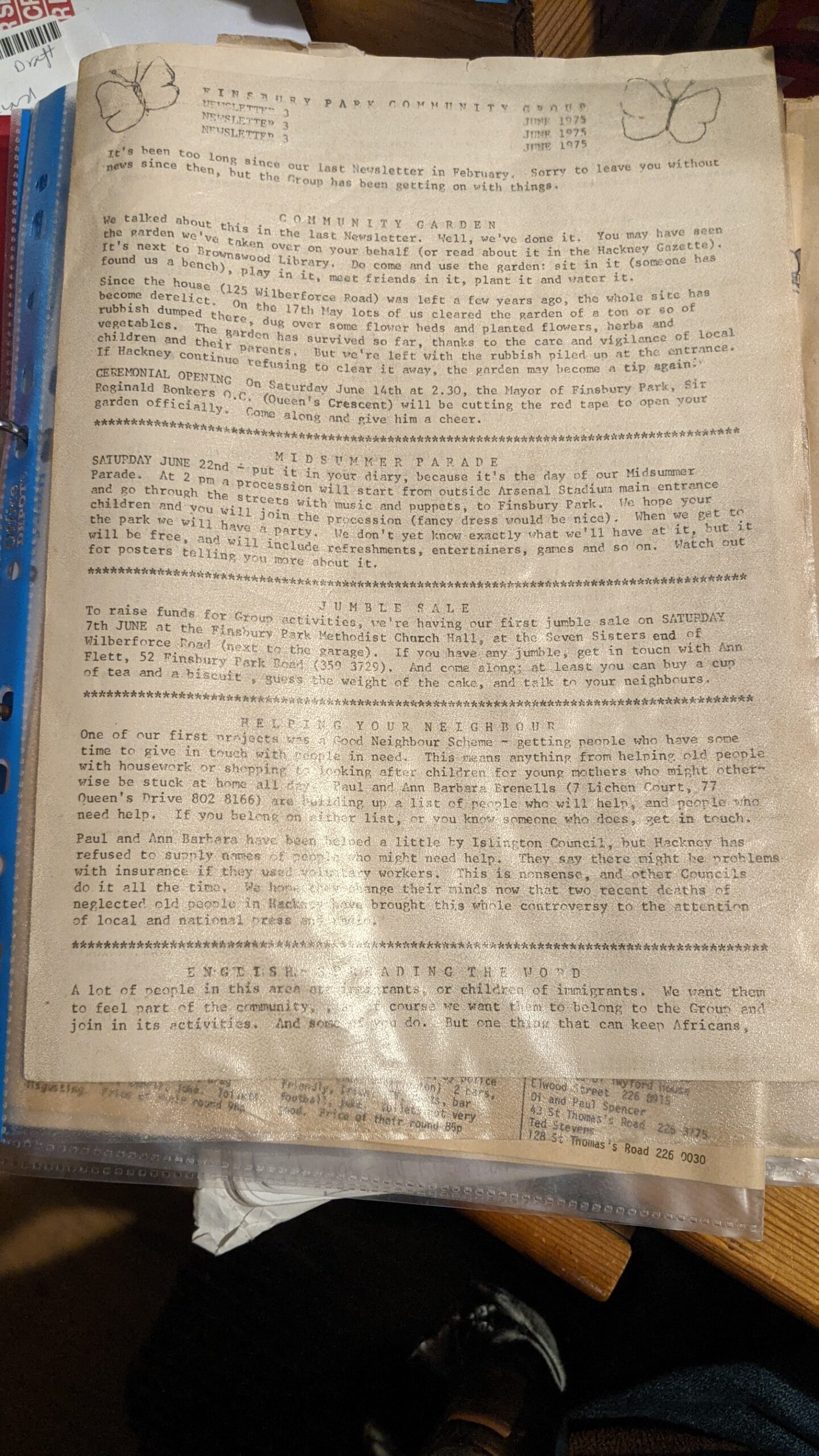
The first issue from June 1975 of the Finsbury Parker (c) NB for Islington Faces
1 Issue Number One in June 1975 starts off positively. “We’ve done it… taken over the garden” at 125 Wilberforce Road, next to Brownswood Library “on your behalf”. Dorothy says it was a very memorable event: “There was a big march with Judge Bonkers (a big puppet) starting from Somerfield Road. All the children and adults marched together and then got planting. You could see for years the words on the wall that said, ‘this is your garden’. It was very good fun and a lot of people enjoyed it.”
Sadly, Brownswood Library was closed in the 1990s. It was squatted from late 1995-1999. There’s some info about this on a Hackney blog https://hackneyhistory.wordpress.com/2023/01/08/struggles-to-save-hackney-libraries/ which adds that the library was squatted again 2008-09, then demolished and housing built on it. Nowadays we do have the N4 Library, in Blackstock Road, managed by Islington. Dorothy says: “We used to put the Finsbury Parker together in the library, amongst other community venues. It was literally cut and paste. I’d often take it up to War on Want the charity in Caldedonian Road and they’d print it. We also used the printers in Monsell Road, which is now a house.”
The group had several working parties including Streets & Amenities, Housing, Traffic and Community Premises. The Housing working party reports in Issue #1 that it has compiled a list of empty houses: “If you want to help in the next stage – pressurising the councils to do something about this get in touch with Paul.” While Brian from Traffic warns: “This is a big job, and it’s linked to many other problems – housing, cruising cars, shopping facilities.”
There’s also a hint of an intriguing history when the writer asks: “Who can remember when the inside of the tube station was painted by art students?”
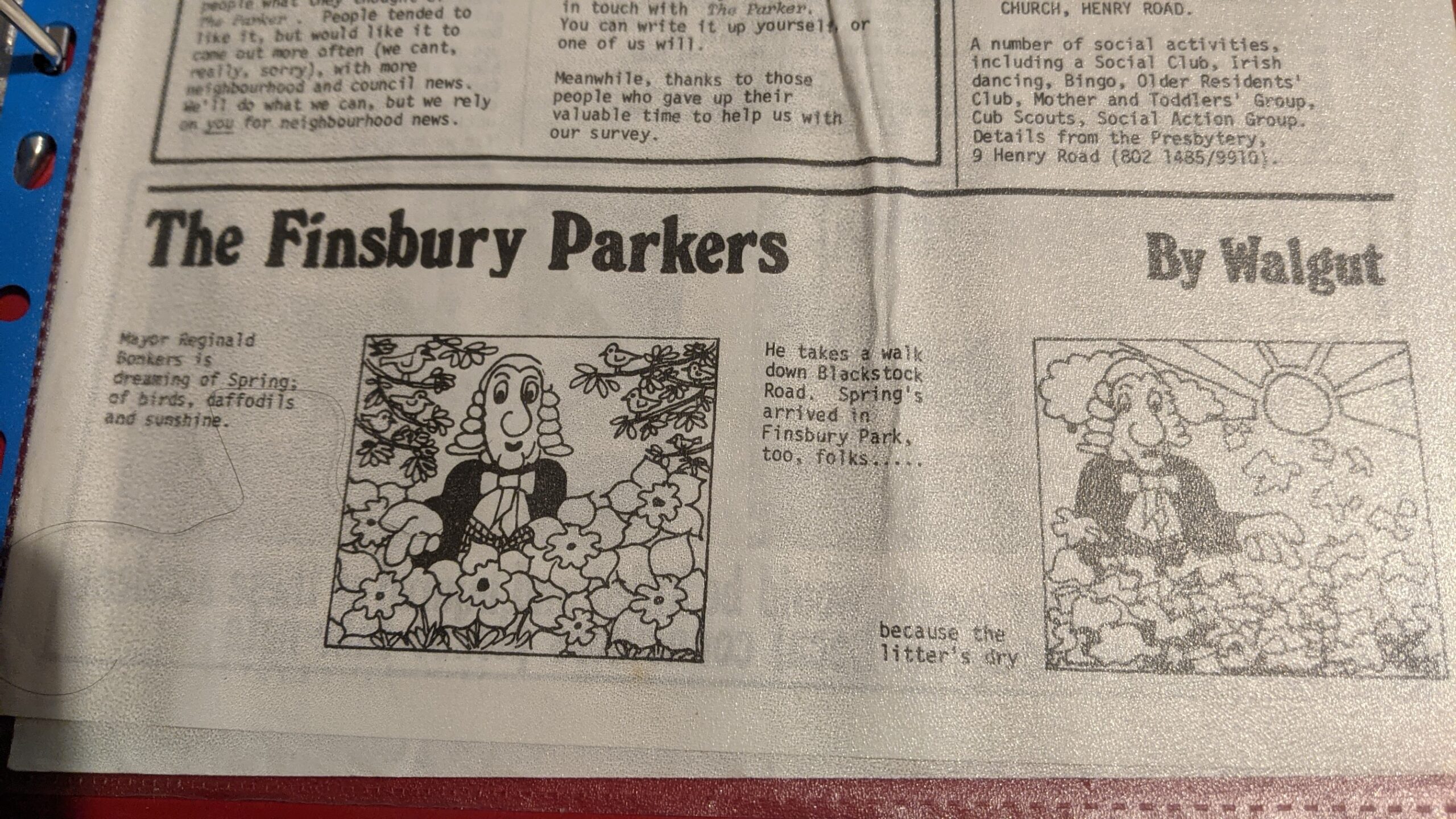
Cartoonist Walgut’s witty observation. From the Finsbury Parker (c) NB for Islington Faces
2 Issue Number 2, December 1975 wants to find a safe way to get across the A503/Seven Sisters Road. The main story points out there are only two crossings, one by the George Robey pub (see good anecdotes about this now lost pub (demolished in 2015) in https://history-is-made-at-night.blogspot.com/2010/05/george-robey-lost-london-venue.html The other crossing is by Wilberforce Road. “That’s about a quarter of a mile of cars, lorries, juggernauts and buses. It makes crossing a real hazard for everybody, and an actual danger for the elderly and the young.” Finsbury Park scored a real victory when a pedestrian crossing was installed – one which we all take for granted now.
Dorothy says: “We all said we’d lay down in the road. We made a line across, but we didn’t in the end have to. Led by Margot Sreberny (this is way before she was known as ‘Mrs Finsbury Park’ as at that time she was working as a special needs teacher) we were determined we were going to get that crossing. I think about her every time I cross it.” See this appreciation of Margot’s community campaigning from the Camden New Journal in 2007. https://www.camdennewjournal.co.uk/article/mrs-finsbury-park-margot-sreberny-inspiration?sp=8&sq=argo
We were hooked by the Finsbury Parker’s pub guide. This was the time when a pint was generally 85p. Most expensive was the Gunners at 92p, and cheapest at 84p at the Plimsoll Arms (now called the Plimsoll, where you’ll buy a Guinness for £6.20). How nice that these pubs still exist, although who knows what our 1975 beer drinker would think of them?
3 Issue Number 3, March 1976 worries about a row of houses that Islington has compulsory purchased, deemed unfit, at numbers 206 (a corner shop), 208 (Georgian cottage), 210 (early Victorian with rare panes), 214 (early Victorian), 216 (unusual Georgian style from the 1850s), 218 (ditto), 222 (“best of the lot” rare 19th century home) and 230 (tailor and dressmaking shop) on Blackstock Road. 212 Blackstock Road and 2 and 4 Conewood Street, all in OK condition, were added to the demolition list to “make a neater site”. “The Finsbury Park Community Group says, “come off it Islington… we’ll try to get the buildings listed as having architectural merit.” As Islington Faces knows the demolition – despite a lot of local opposition – went ahead. Without access to these newsletters how would any of us know? In fact the group had an additional reason to be upset as they met for a while every last Thursday of the month in 220 Blackstock Road.
4 By March 1977 (#8) the plans to knock down 206-230 Blackstock Road went to a Public Enquiry. The Finsbury Parker writes that “it is estimated that 40% or more of houses destroyed in London in clearance schemes were capable of being improved to a good standard at less cost and less disruption than rebuilding.”
Dorothy says: “We worked closely with community worker Mick Molloy who was based in the Social Services’ neighbourhood team at their then new office in Blackstock Road which had been Pickford’s local office (now a housing association office).”

From the Finsbury Parker (C) NB for Islington Faces
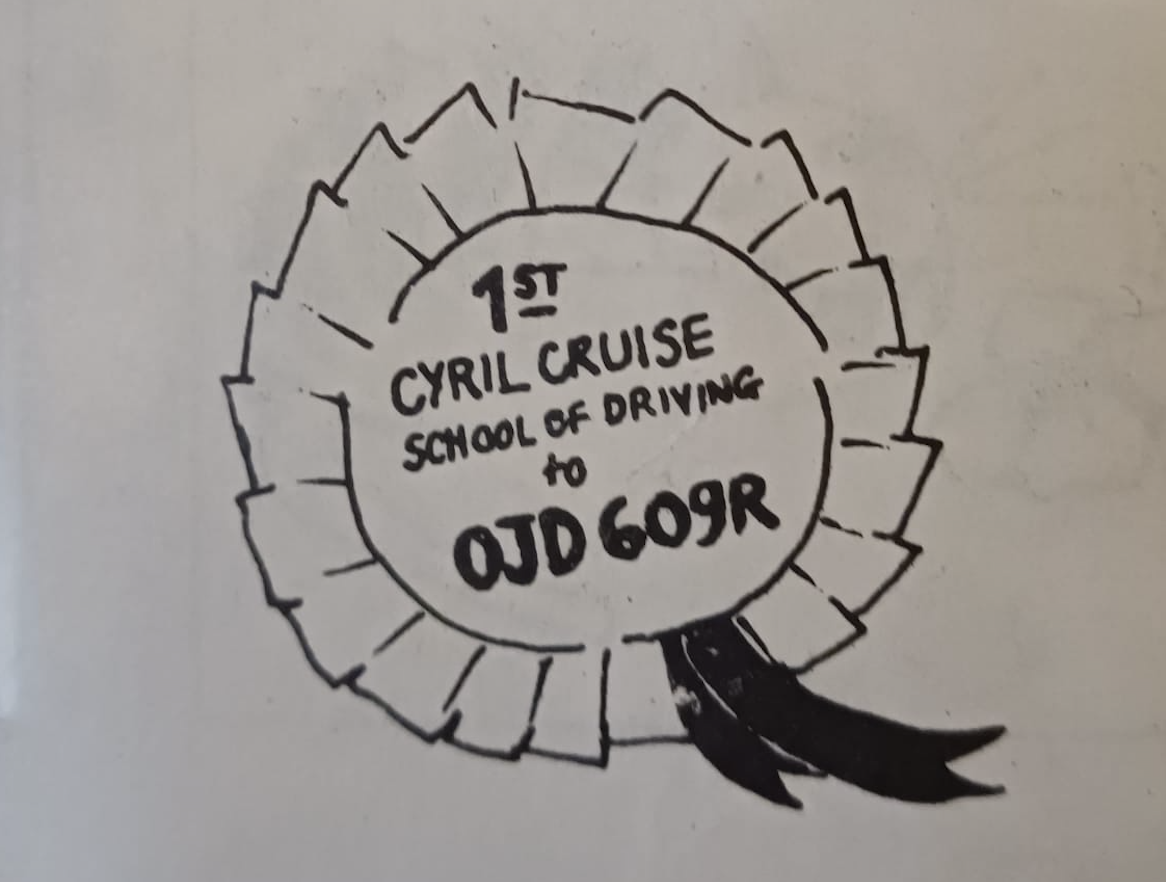
5 In May 1976 (#4) the Finsbury Parker’s lead story is ‘Prostitution – it’s our problem… according to one Sunday newspaper it’s the pick-up centre for Britain. We all see the trading taking place on street corners – we’re all bothered by men kerb crawling (in their firm’s car) beckoning to anybody. It means that a lot of women round here are afraid to go out after dark, afraid to open their doors. One woman looked through her window and immediately got a knock on her door from a passing punter: he thought she was soliciting.” If you ever wondered why Somerfield Road, Wilberforce Road, Queen’s Drive etc were ‘traffic calmed’ long before Low Traffic Neighbourhoods were a thing, you now know – it was to stop cruising drivers.
From the Finsbury Parker (C) NB for Islington Faces
Dorothy says: “We had to do something about it! We enjoyed making up the Cyril Cruise Award car number in the Finsbury Parker to draw attention to the problem.”
6 In 1976 (#5) the ‘Nosey Parker’ column gets sniffy about rumours that the GLC is spending £100,000 on an angling lake in Finsbury Park.
Silver Jubilee poster (July 1977) from the Finsbury Parker (C) NB for Islington Faces
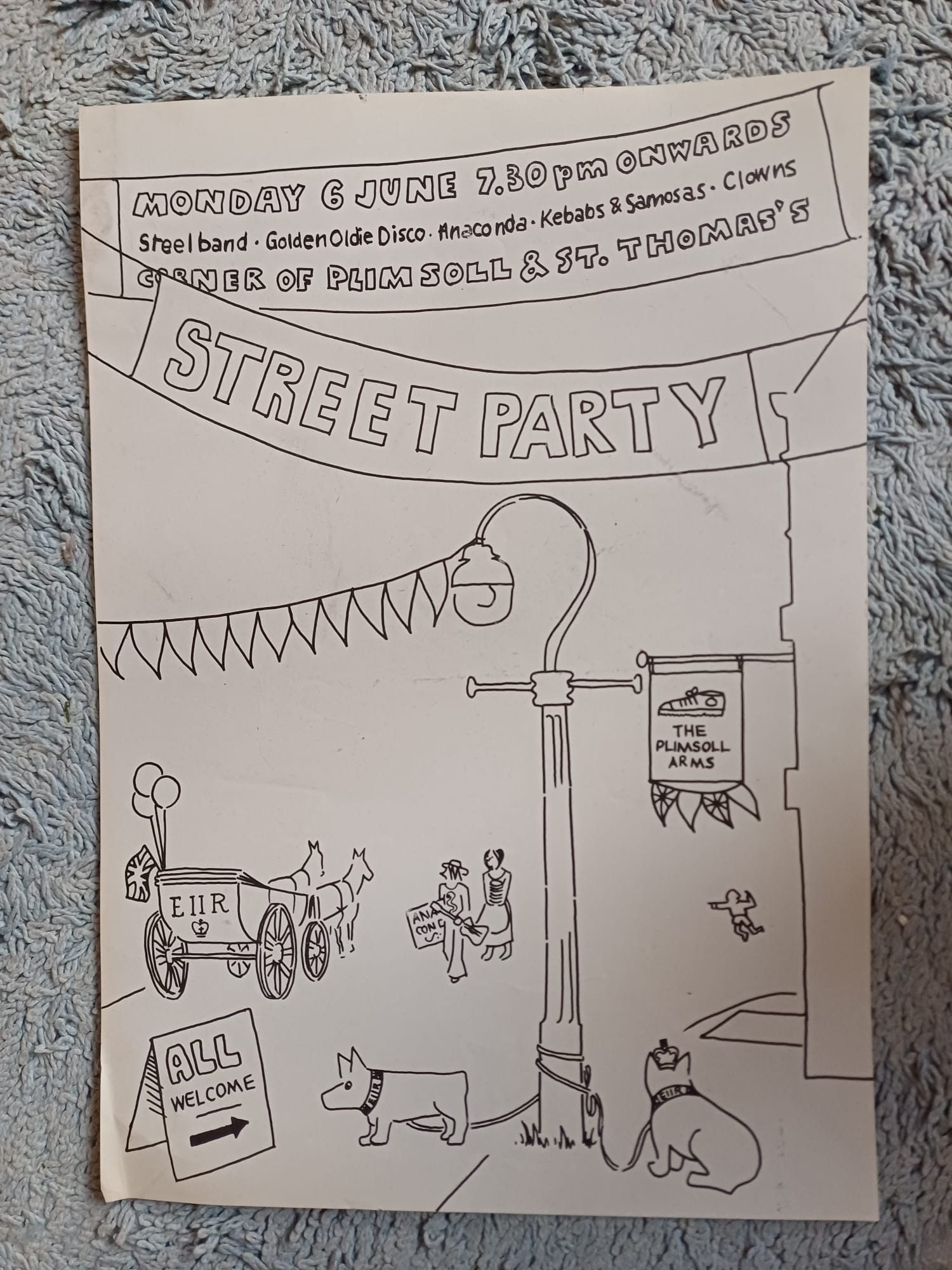
7 In the issue of July 1977 (#11) the team report a successful street party held on 6 June, as part of local Silver Jubilee Celebrations, by the Plimsoll Arms. “We had a disco, steel band and a rock band, anaconda kebabs, pizzas and samosas,” to which at least 1,000 people came. “It got the whole community together. They could not move in the pub and hardly in the street.”
8 By October 1977 (#12) Blackstock Road Advice Centre at 220 (still not demolished) offered legal help on Wednesday evenings plus welfare support on Thursday mornings. The new part time worker was Ian McEwan. “His job will be to work with tenants in the proposed Housing Action Area in Finsbury Park.” In the same issue teenagers take over to argue the case for youth clubs to “bring teenagers off the streets and stop them making trouble and getting the police involved.” Well, what do you think, have things improved for teenagers in Finsbury Park nearly 50 years later?
9 Fast forward to July 1994 and The Finsbury Parker (#91) reports that “planning consent has been approved to turn the Victorian folly on Green Lanes into Britain’s largest climbing centre,” with the help of architects Nicholas Grimshaw & partners (“responsible for the Camden’s Sainsbury’s”). While inside there’s an update on Arsenal’s proposed move to the Drayton Park goods yard.
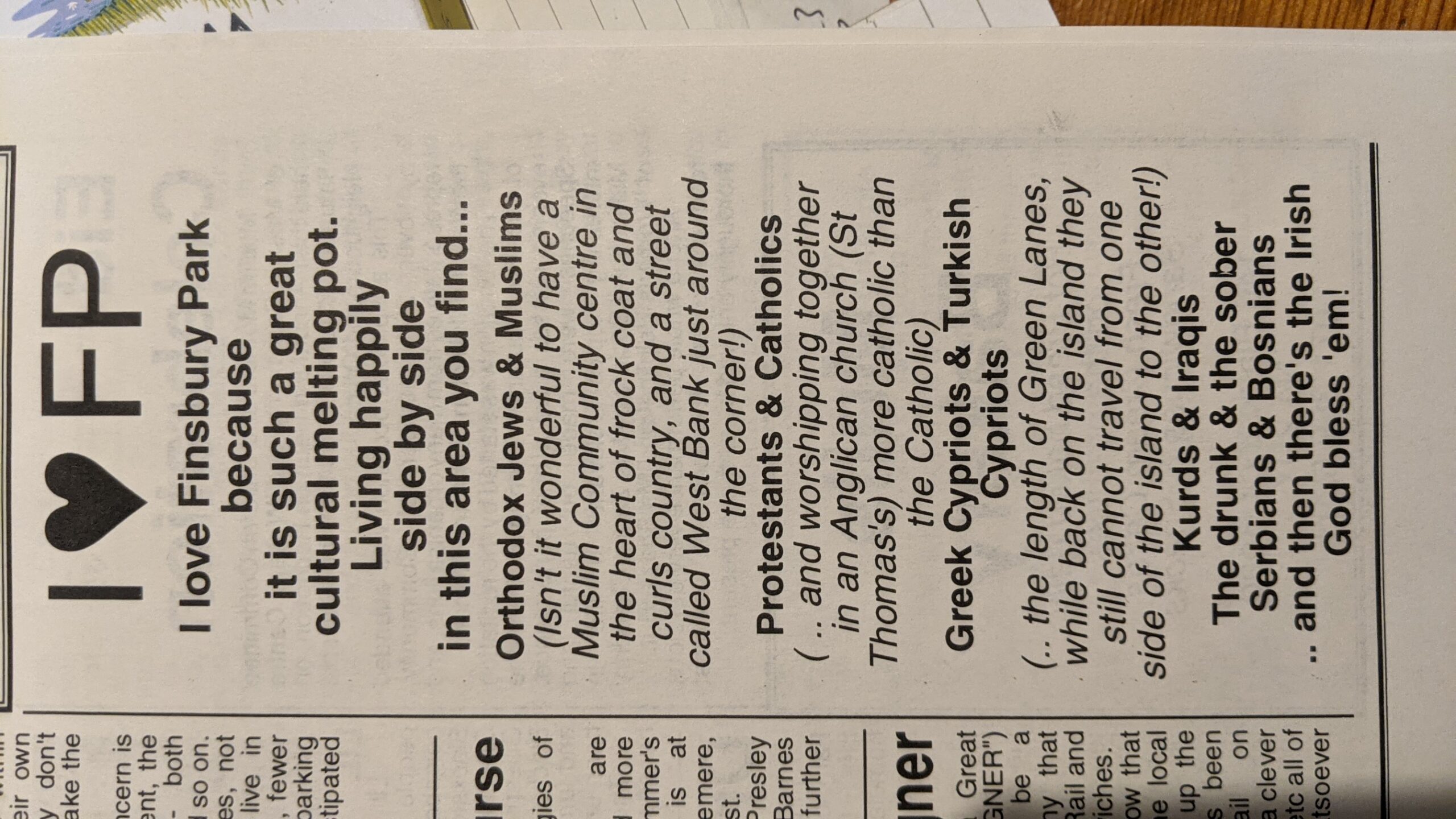
10 By Spring 2001 (#106) The Finsbury Parker, now billed as “a free community newspaper, written and produced by the community and supported by advertising from local businesses”, with an office address at FPAG, Alexandra National House, 330 Seven Sisters Road, is reporting on the plans to improve the areas around Finsbury Park station, in particular Station Place and Wells Terrace. The magazine now also has a website at www.finsburyparker.co.uk (sadly not a live link).
Dorothy says: “As the Finsbury Park Neighbourhood Group we’d been an informal, voluntary group but Finsbury Park Action Group (FPAG) was a constituted group with paid workers. Margot was the really active chair of this new group and that led to the SRB (the single regeneration budget) which brought £25 million to the Finsbury Park area, with the Finsbury Park Partnership which was chaired by Paul Morris. It was the first voluntary sector led SRB in the country. One legacy was the Finsbury Park Trust buildings at 225-229 Seven Sisters Road, currently run by Felicity Ford who’s doing such good work in the whole area.”
From the Finsbury Parker (c) NB for Islington Faces
These Finsbury Parker magazines make very clear how much we owe to those earlier community activists – in particular for that pedestrian crossing on Seven Sisters Road. Ultimately the Finsbury Parkers efforts at being good neighbours also led to the creation of the Finsbury Park Partnership which aimed to bring all sorts of regeneration benefits to this area. Thank you all, and especially to Dorothy for sharing these copies.
Dorothy says: “There are so many people active in Finsbury Park still – running all sorts of events, from play streets to street parties. People still really care about the area and make people feel at home. When we started the Finsbury Parker and the Finsbury Park Neighbourhood Group we were lucky as most of us were youngish with small children, or just about to have them. We did community food buying, we had a babysitting circle with tokens, there were so many things we tried that helped us feel rooted.”
Perhaps that’s the secret – finding ways to make everyone feel that Finsbury Park is where you belong, but also never giving up that campaign spirit of the original Finsbury Parkers.
Find out more
- Hackney Library has a complete set of Finsbury Parkers in its archive. Islington Library has many copies too and Dorothy is hoping to make sure they get a complete set.
- Finsbury Park Trust https://www.finsburyparktrust.org/
Over to you
If you’d like to nominate someone to be interviewed who grew up, lives or works in Islington, or suggest yourself, please let me know, via nicolabaird dot green at gmail dot com. If you enjoyed this post you might like to look at the A-Z index, or search by interviewee’s roles or Meet Islingtonians to find friends, neighbours and inspiration. Thanks for stopping by. Nicola