Estimated reading time:15 minutes, 18 seconds
Everyone has a story. In the 1970s and early 1980s Islington was famous for its squat culture. Back then politicians from Labour, and even the Tories, were forced to accept squatting as a way to bring abandoned and neglected homes back into use. Plenty of young people found cheap homes but also used these spaces to create community projects – from music and art studios to bookshops and nightclubs. Here Steve Platt shares just a few of his memories from 10 years squatting around Islington. Interview by Nicola Baird

Steve Platt with car outside Islington Community Housing (ICH) office (specialising in short life housing) on Hornsey Rise, around 1980-81. © SP
Steve Platt is a very special interviewee as Nicola from Islington Faces worked for him more than 35 years ago. At the time Steve was editor of the New Statesman magazine and daily chat was politics, lunch choices and deadlines. I knew he’d been part of Islington’s thriving squat world back in the day, but it’s taken a while to find out more.
FOLLOW Islington Faces, a new interview is published approx once a fortnight.
Steve, who grew up in Stoke on Trent, had been briefly homeless before coming to London in the summer of 1973, aged 18. As the housing situation is very different 50 years on, it might be useful to clarify what the terms squatting and short-life housing mean.
- Squattingis when you live in a house without the owner’s permission. You don’t pay rent, but you do pay for services and repairs.
- Short-life housing is now usually organised through a housing association (or housing co-operative) who will give a licence for use while the building is waiting to be refurbished, demolished or sold. However, it’s usually only for a short period (eg, three months to a year or so) and you can be evicted at any time with limited notice. You pay rent and for services.
Q: What was Islington like in the 1970s?
“It was a city that was still losing population [because people were moving out]. It seems almost unbelievable now but there were whole areas where people just didn’t want to live. There was actually a category in council housing called ‘difficult to let’ because no one else would have it, and which was offered to people who wouldn’t normally get council housing, like single people.
“Then on top of that, you’ve still got the aftermath of the war. You’d got huge areas that were earmarked for demolition, or refurbishment, with literally thousands of homes, empty, waiting for that to happen. For me the war felt like a million years ago but there were still bomb sites. London had never really recovered properly. The industry was closing. The docks were closing. People were moving out – apart from a few small areas where there was the early kind of gentrification. Famously in Islington this was Barnsbury and Canonbury done by the pioneer gentrifiers.
“Those people would move into streets or squares where there was very run down private housing converted into multiple lets, bedsitters and so on.”
The councils were on the case. From the early 1960s they’d been buying up property with a view to redevelopment. This led to a huge amount of demolition taking place. On Islington Faces we wrote about some of the Georgian houses pulled down for this reason along Blackstock Road see here.
=============

Squatting in the 1970s and 1980s wasn’t just a roof over your head at an affordable rate, but also a chance to learn practical DIY skills, slot into a community and have space to try out creativity. Steve Platt: “Most of the places I stayed in (squatted) had some kind of agreement with the landlord, which would usually be the council, but not always.” © Nicola Baird for Islington Faces.
Places Steve Platt loves in Islington
I have always loved the PARKLAND WALK, even when it was still a derelict railway line. I think it’s long enough ago now to say that a very strong and lovely neighbour and I used some of the granite slabs from the old Crouch End station to make a garden pond. They’re probably the heaviest things I’ve ever moved in my life. Before it became the Parkland Walk, you could still walk along it, and you used to be able to go through the tunnels if you were brave into Highgate station. I did a lot of running along there. There’d be the occasional dog walker and maybe kids. One of my great memories is of hearing this sound like a train behind me and the ground shaking – it was Frank Bruno out training. He was literally twice my size and was coming up behind me like a steam engine.
REGENT’S CANAL The canal near King’s Cross was wonderful. I love it now but that whole period when it was semi derelict, when it was between uses, I loved that whole area and the almost ‘anything is possible’ nature of it. One bank holiday, probably 20 years ago, they had a festival within various empty buildings. There used to be something called the Church, which was a sort of massive pub-cum-nightclub, famous for its wild Sunday afternoon party scene. I used to love just going through holes in fences in that whole area around Camley Street nature reserve, to see what was on the other side – it was like a massive adventure playground for adults. It was a rough area. There’s no getting away from it but I don’t think it was as dangerous as it often appeared, yeah. And actually, at the time when you had a lot of the street walking prostitutes in many ways it was safer than it was without them. The women knew the area and would look out for trouble. More info about the canal from Friends of Regent’s Canal and the Canal and River Trust.
HORNSEY RISE Back then the eccentrics were drawn there, or lived there, and it felt like there were endless possibilities. Islington Community Housing (ICH) had its offices here on that triangle of Beaumont Rise, Hornsey Rise and Cromartie Road, with the Favourite pub on the corner. The area in the middle of that triangle was basically a wild open, unmanaged space – you could be almost anywhere in the country, now it’s a health centre and ICH Co-op owns Cromartie Road and has houses there. The goatman lived at the back of the ICH office on Hornsey Rise. One of my first tasks when I was co-ordinator of ICH was to deal with the issue of the goatman and people keeping dogs, ducks and chickens at the back. That goat would chew the floorboards of houses and things. The goatman was harmless, but there were people who definitely weren’t harmless who came into squatting; he was just eccentric.
One of my oldest friends, who also worked for ICH and died earlier this year (2025), was David Bennie. His dad was blind and played the piano for a time in the Favourite, a big, now-demolished pub
The area had this whole history and character about it. And then just to the south the council created the Peace Garden at a time when creating something called the ‘peace garden’ was seen as being loony left activity, rather than just a nice place. Like a lot of open spaces, it’s suffered from the problem of how you deal with antisocial behaviour. You can’t deny that it’s a problem, but at the same time it’s a lovely space. The Phillip Noel Baker Peace Garden is in Elthorne Park, N19
SUNNYSIDE GARDENS set up in 1977 is another example of the kind of things that were going on in that locality. It’s the opportunity that those spaces give for all kinds of things that never make money.
There’s a TREE OF HEAVEN that gives me great joy and pleasure every time I see it at Carleton Road, N7 on the Junction with St George’s. It is magnificent and well over a century old. It probably dates from when the houses themselves were built. In Islington there are a few beautiful old trees, but that one in particular doesn’t appear to have been savaged by people acting on behalf of insurance companies or so-called tree surgeons who think tree surgery just involves cutting off limbs. Because of the way those roads join, it’s got the space to grow.
I like the UNION CHAPEL Last act I saw there? Billy Bragg.
ALMEIDA THEATRE: Stan, my grandson is 18. Among many other things he’s really into theatre and it is really challenging for me to remember the different plays I’ve seen with him.
==================================

Steve Platt in Jav’s Cafe (as was), Hornsey Road, around 1980-81. © SP
Q: What drew you to Islington?
“When I first came to London, there were friends in Tooting, and I stayed with them and I lived in Tottenham for a while, private renting and staying on friends’ floors. I’ve forgotten [exactly] who I knew in Islington, but I think it was people who had squatted in Islington, or knew about squatting in Islington, that led me to it in the summer of ’74.”
I lived in probably no more than half a dozen different places around Islington until I got my first permanent tenancy in 1984 – and I also lived with [my daughter] Rachel’s mum for part of that time in Hoddesdon, Hertfordshire.
Historically, the movement of people out of London especially in the ‘50s and ‘60s was those who lived in Islington or the Tottenham area would move north up the Lee valley into Hertfordshire and those who lived just a bit further to the east would move eastwards into Essex. It’s that thing of you know one person and then a little community builds up. And you can never underestimate the importance of a football team in people’s sense of their locality (which explains why Steve’s team is Port Vale).
Q: Were there jobs?
By now Steve was at the LSE doing an economics degree. He was also working for the GLC supplies depot, in Tottenham not far from the Gestetner factory (which made office copying machinery, employed around 6,000 people and had been originally established in Cross Street, N1. There’s a plaque at 124 Highbury New Park where the founder, David Gestetner lived from 1898 until his death in 1939) which occupied the whole of one side of Broad Lane.
“The GLC supplies depot supplied everything to do with the Greater London Council, so that was offices, schools, housing. You could get anything in there from leather inlaid desks for the senior civil servants to book ends. It was in Tottenham Hale and massive. It would compare with an Amazon warehouse today. Staggering changes have happened there over the years. Of all the places I know in London. I think that Tottenham Hale is the possibly the least recognisable to me.”
Q: What was squat life like?
“The first squat that I lived in was in Shaftesbury Road, off Hornsey Rise. I very quickly became involved in active squatting, opening up empty houses and being part of campaign groups to bring houses back into use with the Advisory Service for Squatters on St Paul’s Road.
In the early ‘70s there was a split between family squatting and other squatting. The family squatting had come about as an alternative to putting homeless families in hotels. And it had involved some quite hairy direct action. People like Ron Bailey and Jim Radford were famous. Ron Bailey wrote a book called The Squatters for Penguin. Bailey and Radford had basically realised that under old common law as long as you didn’t use force to enter a property you weren’t committing an offence. It was a civil matter, so the police couldn’t get involved. You could only be removed by court order. Most of the empty houses at the time would have had a broken window or a door that was insecure, so it was very easy to get into them without breaking and entering. It was also easy as often every other house around it was empty.
“Squatting was growing in London particularly, but actually all over the country right through the ‘70s, and the best estimates were that at its peak there was something like 50,000 squatters nationally, with perhaps 30,000 in London. As a result of that councils and other property owners would licence squatters to use empty houses until they needed them.
They became known as the licenced squat movement which then became short life housing groups which then evolved into formal housing cooperatives and permanent housing. In Islington the biggest group was Islington Community Housing (ICH). There was also Islington Community Housing Co-op, which developed the permanent housing. But there were a lot of other organisations as well, like Finsbury Park Housing Co-op (at 12 Pine Grove, also just off Hornsey Road) which started as a squatting group, and still exists.
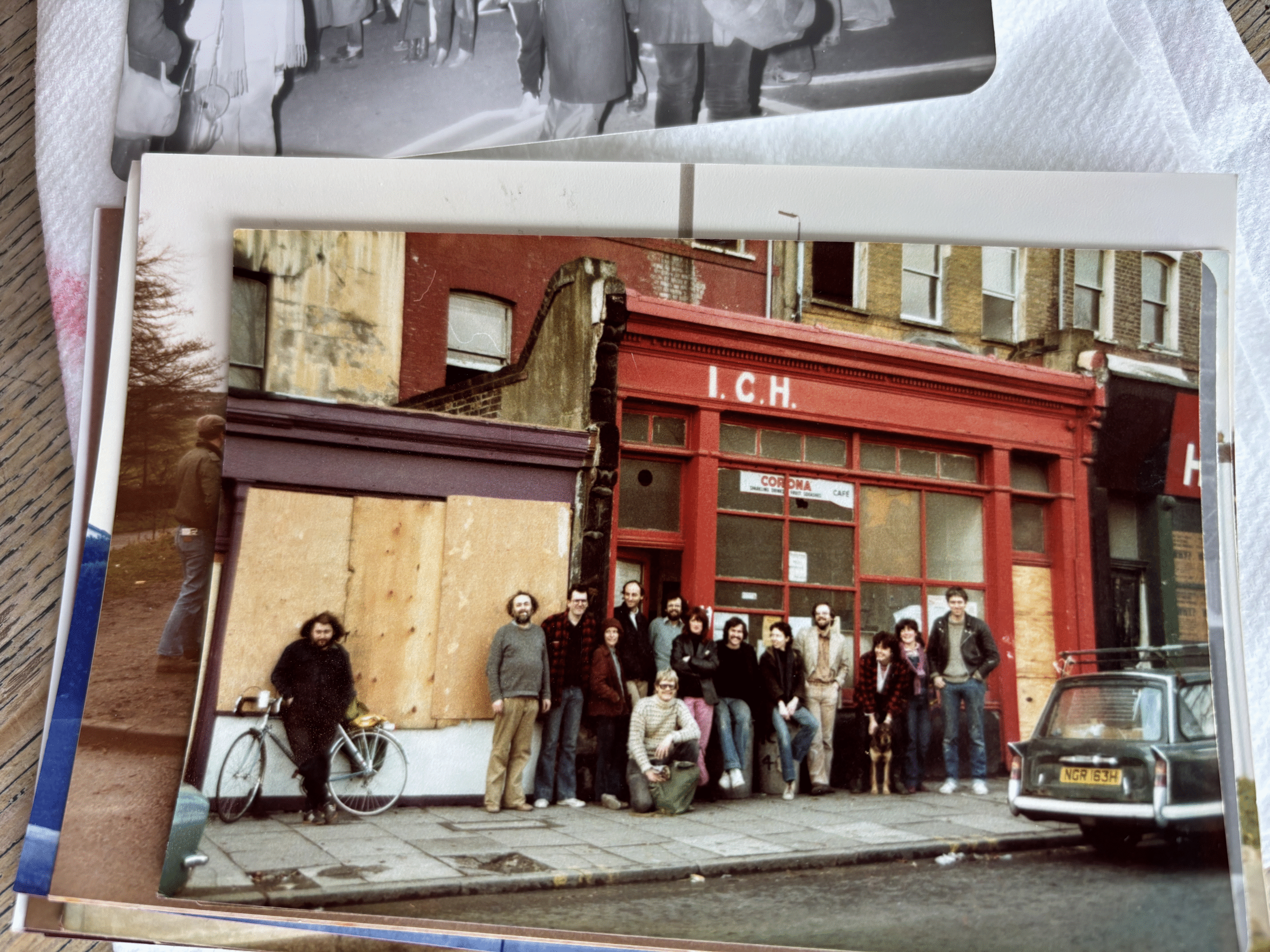
Islington Community Housing (ICH) workers outside the office on Hornsey Rise, around 1980-81. © SP
Q: How did the co-ops interact with the council?
Steve worked for Islington Community Housing (ICH) for about four or five years.
“At that time, housing co-ops were favoured by governments of both persuasions, both Labour and Conservatives, who saw them as an alternative to council housing.
“Labour councils saw them as a way of enabling tenants to manage their own housing. And Islington was very much a forerunner in that – Holloway Tenants Co-op, which is nothing to do with squatting, was one of the pioneers, enabling council tenants to manage their own housing. It was one of the most famous nationally, but I don’t think it exists anymore. For a time housing co-ops were seen as a great alternative to either council housing or private ownership. These were mostly permanent leases, but the short life housing could be anything from a few months to many years.”
“The whole thing has come full circle, really. Housing co-ops started in a large part as a reaction to big, impersonal and remote local councils. But now you have housing associations like Clarion (which took over Circle 33 locally), which are way bigger than any council ever was. Clarion has houses all over the country and are about as remote and impersonal as you can get. When you contact them, you go to a call centre. I think in Clarion’s cases it is in Newcastle with no local knowledge at all or knowledge of particular houses. So, with every minor issue you have to go right the way back to the beginning again.”
Read & learn
“What squatters were able to do that councils, and others, couldn’t, was that they could be flexible and innovative. You’d have no hot water, but you could cannibalise an old boiler from another derelict house. It was a hugely practical approach. There was another Penguin book, a best seller called the Self-help House Repair Manual, by Andy Ingham (1975), originally titled Squatters Repair Manual but Penguin decided this would have a much bigger appeal with the Self-help name.”
The Advisory Service for Squatters used to publish the Squatters Handbook, which was updated regularly and went through many editions. It was halfway between a pamphlet and a book that contained everything about the law on squatting, with contact addresses and a very big section on do-it-yourself repairs, like how to wire a house or do your plumbing.
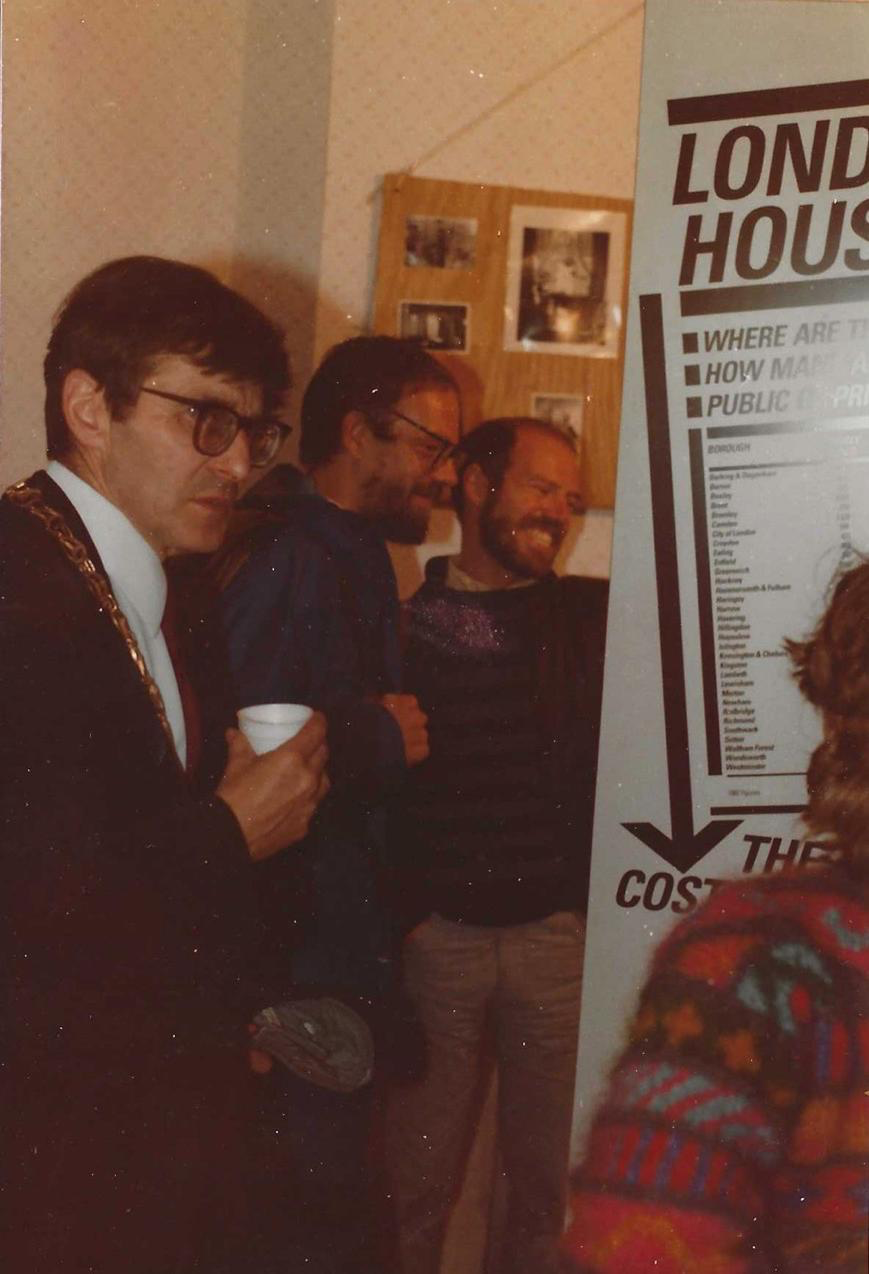
Steve Platt (middle) with Bob Marshall of the Empty Homes Campaign and Islington Mayor Pat Haynes in 1983. © SP
Creative life
“At one end of the spectrum, squatters would take over absolutely empty derelict houses and make them habitable. You weren’t paying any rent, but it wasn’t actually free because you’d still have to pay for services and whatever repairs you did. But it enabled a lot of people to do things they wouldn’t have been able to otherwise. There was a huge number of musicians, artists and creative people squatting. From the mid-‘70s to mid-80s people will tell stories of a period in their lives when they were squatting, The Clash, for example, famously got going in squats, as did Boy George. Andy Bell of Erasure started off in an ICH house. Most of the early ‘80s musicians and the New Romantic scene had some kind of connection with squats, not just as places to live but as campaign bases, cafes, bookshops, printshops, studios and impromptu nightclubs. Islington had all these at one time.”
With rents so high now – a two bed in Islington costs close to £3,000 a month – tales of the ‘70s and ‘80s squatter experience seems like a beautiful dream. The irony is that there are still empty houses (maybe as many as 87,000 in London) but laws against squatting are far more aggressive.
Here’s hoping Steve will be inspired to collate more stories about squatting and the housing co-op movement in Islington. He’s already written some for the book Squatting: The Real Story (eds Nick Wates and Christian Wolmar) published in 1980 which is available online at https://en.squat.net/wp-
If you’d like to share your story about squatting experiences in Islington then do please get in contact with Islington Faces.
Useful contacts
- Islington Community Housing Co-op, see https://www.uk.coop/directory/islington-community-housing-co-operative
- Finsbury Park Housing Co-op, see https://e-voice.org.uk/finsbury-park-housing-co-operative/
- In 2023 another squatter in the Hornsey Rise area, Jeremy Worman, collated his memories in the autobiographical novel The Way To Hornsey Rise.
Over to you
If you’d like to nominate someone to be interviewed who grew up, lives or works in Islington, or suggest yourself, please let me know, via nicolabaird dot green at gmail dot com. If you enjoyed this post you might like to look at the A-Z index, or search by interviewee’s roles or Meet Islingtonians to find friends, neighbours and inspiration. Thanks for stopping by. Nicola