Estimated reading time:12 minutes, 49 seconds
Everyone has a story. With Islington in Bloom competition marking its 20th year of gardening prizes in 2023, one of the judges, Dorothy Boswell, talks about the ways gardening can bring us together as we create even more wildlife-friendly and climate-aware gardens. If you love planted up tree pits or admiring front gardens around the borough here are some tips to make Islington bloom in a way that’s even better for bees and other insects, birds and bats. Interview by Nicola Baird
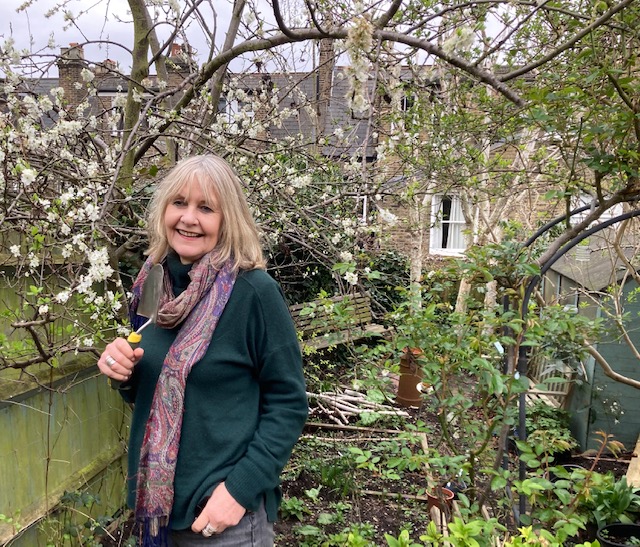
One of Islington in Bloom judges is environmental campaigner and wildlife gardening advocate, Dorothy Boswell came to London for university at Goldsmiths. After living in Deptford and then Clapham, she was based in Dartmouth Park for 10 years before moving to Archway where she’s been for 18 years. (c) DB
Dorothy Boswell is one of those friendly people who tries to use her fountains of energy to improve the community. Although she is “sort of retired” after a career as journalist, teacher and parenting councillor she’s constantly busy with environmental actions that boost Archway and ultimately the whole of Islington.
FOLLOW Islington Faces, a new interview is published once a fortnight
Dorothy lives in Archway in the Whitehall Park conservation area, and helps organise the Harberton Road, N19 street party. “During lockdown, when people couldn’t congregate, we had a walk-through green festival, held over a week or two. We labelled the street trees with their names, information about birds and local wildlife, showed which houses have solar panels (and how much energy they generate) included stuff about recycling and food waste and we had a bike maintenance workshop. We were trying to not just have a street party, but to do something with legacy and meaning. Through the Greener Together funding we applied to get a parklet – with planting and seating – outside our local shops on Cressida Road. There’s been a brief delay because it’s quite a steep hill, but it looks set to be in place during autumn 2023.”
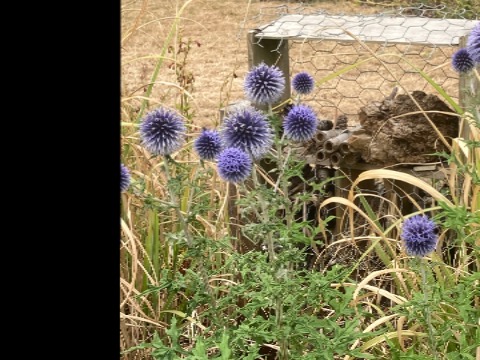
Anyone can enter the Islington in Bloom 2023 competition (entries close 19 May 2023). You don’t even need your own garden, just nominate your favourite container gardens or tree pits – especially if you think they are boosting Islington’s wildlife (see the insect hotel in this pic). (c) DB
Judge
This year the Islington in Bloom gardening competition celebrates 20 years. As an active member of Islington Environmental Alliance Dorothy wants to make sure many more of us enter, and do so with gardens or planted up tree pits that benefit Islington wildlife.
“Islington Council have a Biodiversity Plan because I’m a member of IEA and have campaigned against glyphosate (weedkiller) use in the past I looked closely at the Biodiversity Plan. I noticed that it says they would use the Islington in Bloom competition to promote biodiversity among gardeners among the borough, but I’ve been a judge for this for about four years, and this was the first I’d ever heard of it,” she says over Zoom (See the biodiversity plan and Islington’s own sharepoint #1.5 (engagement) to “promote wildlife gardening to residents, schools, estates, business and community groups through the annual Islington in bloom competition”.
| 1.5 | Engagement | Promote wildlife gardening to residents, schools, estates, businesses and community groups through
the annual Islington |
|||
Above: screengrab linking Islington in Bloom competition with wildlife friendly gardening.
===================================

Environmental campaigner and wildlife gardening advocate, Dorothy Boswell: “We want to encourage people to enter the Islington in Bloom competition. You can enter yourself or promote other people, you don’t need to know their names, just put the house/flat number.” (c) DB
Places Dorothy Boswell loves in Islington
- I was a trustee for about six years of Culpeper Community Garden, 1 Cloudsely Road – it’s at Angel. It’s such an amazing oasis in the middle of the city, and so beautiful.
- I live in Hillside, the most northerly ward, most people don’t even realise it is in Islington. We have this fantastic community garden called Sunnyside, on Hazelville Road, open to the public 24 hours a day. It’s not very big but has got a proper pond, woodland, bat boxes and bird boxes and a lovely family garden with story logs, murals, and for toddlers a covered tiny pond with a bridge and a fallen tree with carved owls that’s a seat.
- The Ecology Centre, 191 Drayton Park, in Gillespie Park is great – another urban oasis. It’s got a big pond, woodland and I like the fact that it is a wildlife corridor.
- The Regent’s Canal and the New River Walk are secret paths through the city by water. You can walk along the Parkland Walk from near my home to Finsbury Park then along the New River and to the East and West Reservoirs – a six-mile walk through London and you are in nature the whole time.
- I love Union Chapel – I’ve been to some fantastic gigs – saw Marc Cohn recently. I also sing in the Union Chapel Singers, the community choir who meet there every Sunday and will be in the People’s Messiah with Eclectic Voices. I’ll be up in the balcony singing the ripieno chorus.
- The Almedia Theatre. I’ve been to really great plays here, such as Ghosts (Ibsen). I also go every few months to volunteer as a faciliator at Death Cafes where people can talk about death and end of life issues. Older people come because they’ve tried to talk to their children about it but they won’t listen; and young people come and say that the old people say ‘what are you after?’ or ‘put me out with the recycling!’ there’s no agenda, just talk. Deathcafe.org. The next Death Café (Tuesday 16 May 2023, from 11am-1pm) will be held at the Estorick Collection because of works at the Almedia. Book your free tickets as places are limited, via this link.
- At Ottolenghi, 287 Upper Street, I sometimes had the set lunch, and often have the delicious take-away salads, then looked up the recipe and made it at home. We’re lucky to have someone so brilliant in our borough. On TV, and in the newspapers, he seems such a lovely man, with a real warmth he applies to everybody.
====================
Nature winning tips
“People need to know that one of the judging criteria is that you get less points now for the wow factor – lots of colourful flowers – which you could just buy the day before at Homebase. Now for Islington in Bloom there’s far more focus on biodiversity – drought-proof plants, perennial plants (which come back year after year so don’t need replanting), piles of wood, water, nesting boxes, insect hotels and generally an untidy bit of the garden which would be good for wildlife. Those things score high points on the judging sheet when we look at entries, but they weren’t being publicised to gardeners.
“Often when you talk about Islington in Bloom, people think about a slightly old-fashioned idea of gardening competitions – neat lawns, neat borders and hanging baskets. But frankly lawns are a bit of a desert for wildlife, unless they are allowed to go a bit wild. If you leave lawns for No Mow May, you get daisies and buttercups which are great for bees and butterflies, but if you are cutting them and leaving them with green stripes like a billiard table, then you’re not doing anything for wildlife. And in hot weather hanging baskets need watering three times a day, unless you are very careful about what you plant. (See tips from London Wildlife at the bottom of this page on how to make your lawn more wildlife friendly).
“My interest is letting people know about gardening for nature and also that you don’t just have to enter your own garden. Around the corner on my walk to the bus stop there’s a metre wide space in front of a ground floor flat which the tenants had just filled with containers of plants. I entered it into Islington in Bloom 2022 (when I stood back to take a photo, it almost got me run over because it’s so close to a major London road). They won a certificate and when I knocked on the open window and gave it to them, they were absolutely thrilled, and said how often people walk past and say how lovely it is,” explains Dorothy.
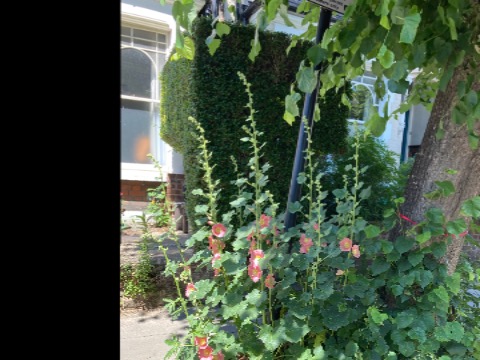
Islington in Bloom judge, Dorothy Boswell: “When I first started guerilla gardening – planting some tree pits in my street – it could be a bit disheartening – there was dog shit and litter; they’re used as ash trays, people tread on plants or even nick them and the council contractors strimmed them and sprayed them with weedkiller. That’s when I first started campaigning against glyphosate weedkiller. It’s a bit better now – Islington says it is reducing the use of weedkillers – by not spraying parks or pavements, and encouraging residents who want to hand weed. Even the councils’ own Enviroment and Regeneration Scrutiny Committee recommends hand weeding but there is nothing about how to do it on the council website and when someone in Canonbury approached the council asking how to get permission to get her street exempted from spraying, the response was they didn’t do that, only tree pits. But several of us have been doing this for a while.” (c) DB
Tree pit love
I got involved in judging Islington in Bloom, which was set up 20 years ago, as one of my passions is tree pits, those little areas of soil around a base of a tree which we all have on our pavements. It’s over 10 years since I started putting little spring bulbs on my road – tete a tete daffodils, grape hyacinths, forget-me-nots and later hollyhocks – all things that come back year after year. Then other people started doing tree pits near them, now there are probably 12 tree pits in my road which have been adopted by guerrilla gardeners. Officially you were meant to inform the council you’d adopted a tree pit so the council would not spray them or strim them. Islington is not quite on top of this, but some boroughs, such as Lambeth, have a really good policy.
Dorothy was so determined to reduce glyphosate use (which has a World Health warning) that she organised a petition against glyphosate in Islington that got several thousand signatures. “But this got sidelined by the last General Election and then covid. As part of this you could apply to the Council and say ‘we don’t want our road sprayed, we are going to hand weed it’. Some people do that, but people don’t know about this and there is nothing on the Islington website. The council has its heart in the right place, but all councils are really cash struck and the info isn’t getting out there about how or why you might use alternatives to glyphosate weedkiller.”
“For pavements there are two ‘villains’,” she adds, “because they break up paving – buddleia and Japanese knotweed. Buddleia is fantastic for butterflies but you don’t want it growing in pavements. When we are all dead and gone buddleia will be thriving! If you have buddleia growing in your pavement you should get rid of it. But unless plants are trip hazards or are blocking the gutter or growing out of the side of the wall, I’m tempted to leave them.” Read what Lambeth is doing to phase out chemical-based herbicides here.
“I totally understand that the council is so stuck for funds, but it’s about communicating what they are doing, and when they are doing something good, people need to know about it and be involved,” says Dorothy adding that it’s the same with trees. “People get frustrated if they report that a tree is knocked over, or not being watered, and don’t get responses, they worry that it’s like Sheffield or in Plymouth when 60 trees were cut overnight, and people get suspicious. We have a brilliant tree department – but no one in the office to explain what they do. The council needs to be better at explaining what they do for biodiversity.
With Islington in Bloom 2023 entries open from 4 April it’s good that Dorothy is keen to share some of the thinking behind the judges’ decisions. All in all, it looks as if this 20th year of the competition is going to showcase some wonderful, wildlife-friendly, climate resilient gardens so do remember to enter your tree pit and garden favourites near where you live.
- Islington in Bloom 2023 competitions open on Tuesday 4 April, with the deadline for entries on Friday 19 May. See how to enter your own or a favourite blooming spot/tree pit here.
- Read Islington’s Biodiversity Action Plan. onsultation/20192020/20200326islingtonbiodiversityactionplan2020to2025web1.pdf
- Find out more about Islington Environmental Alliance here.
- See tips on how to make your lawn more wildlife friendly below from the London Wildlife Trust which also manages the West Reservoir.
=================
HOW TO LOVE A LAWN
Dorothy is a wildlife gardener so suggested sharing this advice from the Wildlife Trusts on how to love your lawn (note plastic grass is even worse for wildlife than keeping your lawn close-shaved).
Lawns left to grow long can help mitigate flooding by better soaking up rainwater, counter the heat island effect in urban areas through their cooling properties, and capture pollutants. They are also better at resisting browning during dry spells than short grass owing to their longer roots. This means that their benefits continue into the height of summer, and provide all-important habitat for a whole host of insects including ants, bees and butterflies. Five ways to love your lawn this year:
- Reduce the frequency of mowing to once every three to four weeks to allow flowers such as dandelion and speedwell to bloom and help pollinators.
- Keep some areas short as pathways, sunbathing spots, and foraging areas for worm-eating birds. For the rest, let the grass grow a little longer, offering shelter to grasshoppers and other insects. In turn, these creatures are food for frogs, birds, and bats.
- Allow parts of your lawn to grow long for the whole summerso that caterpillars can feed and transform into butterflies and moths.
- Turn a blind eye to the odd bare patch within a lawn as these provide sites for ground nesting bees.
- If you do want a luscious green carpet, consider growing hardy yarrow within your lawn or, where there is limited footfall, experiment with a tapestry lawn and grow herbs and flowers such as chamomile and creeping thyme.
=================
Feedback
Nadine: Loved this one! lots of great tips!
Ursula: Thank you; another amazing people-portrait
Over to you
If you’d like to nominate someone to be interviewed who grew up, lives or works in Islington, or suggest yourself, please let me know, via nicolabaird dot green at gmail dot com. If you enjoyed this post you might like to look at the A-Z index, or search by interviewee’s roles or Meet Islingtonians to find friends, neighbours and inspiration. Thanks for stopping by. Nicola