Estimated reading time:14 minutes, 39 seconds
Everyone has a story. Mavis Ring (nee Devine) who was at home having lunch before afternoon classes at Laycock Primary School when the V1 bomb fell on Highbury Corner (27 June 1944) killing 26 people and injuring 150. Here Mavis, now 80 and living in Essex, shares many other memories about growing up in wartime Islington. Interview by Nicola Baird

Mavis Ring with her husband George. Both heard the V1 bomb fall on Highbury Corner. “George was at Barnsbury Central School (housed at Eden Grove during the war) and he was on a tram in Holloway Road heading towards Highbury Corner when the doodlebug dropped. So he was lucky!” (c) Mavis Ring
“Even after all these years away I think of myself as being a Londoner – and coming from Islington. It’s the camaraderie perhaps during the war. We were all poor. We didn’t have anything. We lived together and helped each other,” says Mavis Ring over the phone. She was born Mavis Devine, the youngest of three sisters in Lewis Buildings off Liverpool Road. Her mother was born in Chelsea though she is not sure where her grandmother was born or why the family came to Islington. She’s now 80, but moved to Essex back in the 1960s.
How did your mum and dad meet?
“My mum Connie and dad James met on Highbury Fields. It’s where you went to meet girls (we used to dance). My father followed her up Highbury Fields because she had nice legs. And she did! They were 17 or 18.
My father said he’d watched air balloons going up on Highbury fields. He was six when he moved into a flat at Lewis Buildings with his family. He’d tell us how none of the buildings nearby – Laycock Mansions or Liverpoool Builidngs were there then. It was all farm land!
NEVER MISS A NEW ISLINGTON FACES – on the right panel subscribe to the newsletter by adding your email. Interviews are published once a week.

Samuel Lewis Buildings (c) Islington Faces
What was home like?
You had to have a child to move to a flat in Lewis Buildings which were brick built, with bay windows and reserved for the poor. You couldn’t earn more than so much money a week to go there. My father was a carpenter. When I was 9 or 10 my mother used to send me to pay the rent after school on a Monday. It was 7 shillings and 6 pence for a 2 bedroom flat. We had a kitchen and a lounge too. In the kitchen there was a big enamel bath with a lid that came down on it to keep it closed because we only bathed on Friday! My son who has a spa at his home – was telling his son are you listening to granny ‘she only washed on Friday’. I remember my mother used to say to my father are you going to change those pants (the long leggings that kept you warm) this week?
It’s all changed. We all have washing machines and women are welcome in the work force. “I know when my aunt got married she kept it secret because otherwise she’d lose her job and they’d sack her,” adds Mavis who clearly also welcomes a more liberal attitude to unwanted pregnancies. “My mother said the girls who got pregnant were sent away to Auntie so and so and when they came back they hadn’t got the baby. Where had the baby gone?”

Plaque at Highbury Corner commemorating the people who lost their lives to the V1 bomb. It drastically changed the look of this area.
Tell us about the Highbury Corner bomb on 27 June 1944
- On 27 June 1944 a V1 (doodlebug bomb) fell at 12.46pm at Highbury Corner: 26 people died and 150 injured
- The V1 bomb destroyed and damaged houses on Compton Terrace and on the opposite side hit the Express Dairy (now the tree reserve and part of the roundabout) as well as shops, houses, pub and train station at the northern most end of Upper Street.
“I was about nine or 10. I distinctly remember it. I lived on the 4th floor of the Lewis Buildings and went to school at Laycock Street Primary. That day I had a school friend in to lunch. As my mother was giving us our lunch the doodlebug came over and then it did that awful stop. You didn’t know where it was going to fall. We sat there and waited. Then we heard the bang. My mother said ‘Sit still, mind the glass.’ But there wasn’t any breaking glass. We went to the window and saw the smoke – we thought it was from Tidmarshes the timber yard directly opposite the Union Chapel at the bottom of Laycock Street where my father, who was a carpenter, had gone to get wood for the blackout blinds he made. My mother said ‘Oh my God it is your father…’
The bomb bounced from one side to the other, so Tidmarshes was safe. It destroyed both sides of Highbury Corner including the Express Dairy restaurant where many people were having lunch, and the pub on the corner. There were craters on both sides.
“I think there was a hubbub. We found out a lot of people were killed, including a couple of our teachers. But as children we were never told this. We probably heard our parents talking about it. You didn’t get flowers put on things like you do now. People just got on with it.”
“I do remember one evening my Mother looking at the red sky where the East End was being bombed saying ‘Some poor Devils are getting it tonight’.”
“My elder sister Doreen was working in the Royal Free Hospital in Grays Inn Road. She must have been 19 or 20 then. My other sister, Sheila, was a dressmaker in Oxford Street. They tried to get back to find out if we were alright as they heard a big bomb had gone off in Highbury. But when they tried to get home on the bus they were stopped at Angel. They didn’t know what to expect the other end.”
“By then it was 1944 and my mother still wouldn’t let me be evacuated. She had that idea that if we went, we’d all go together. So we stayed. My mother used to play the piano in the evenings and invite people from the flats around. She used to say ‘If our end is coming we don’t want to hear it coming!’. There were brick built shelters with bunks built in the grounds of the Lewis Buildings – it’s where there’s a round railing area with plane trees – but we didn’t use them until my father had been working at one of the main line stations when it was bombed. That night he came home and said from now on we were going down the shelters.”
“I can’t say I was unhappy. I was at a lovely little school. I’m sure being with your family is how you are made. The air raid warnings used to come in the morning and perhaps the evening. We used to go to school at exactly the same time, at 8.45am every day, and you could guarantee the warning would go, so all the children in Lewis Buildings would sit on the landing watching planes going over. Then the all clear would go and the headmistress would come through the flats ringing a brass bell saying “Come to school’. We’d sit on the landing giggling and wait for our mothers to tell us to go to school. There was no taking us there!”
“I’ve written a long poem about it all which finished up saying how my friends and I were, ‘Too young to appreciate the serious side of war.’ We were children. We weren’t traumatised by the bombing from the sky.”
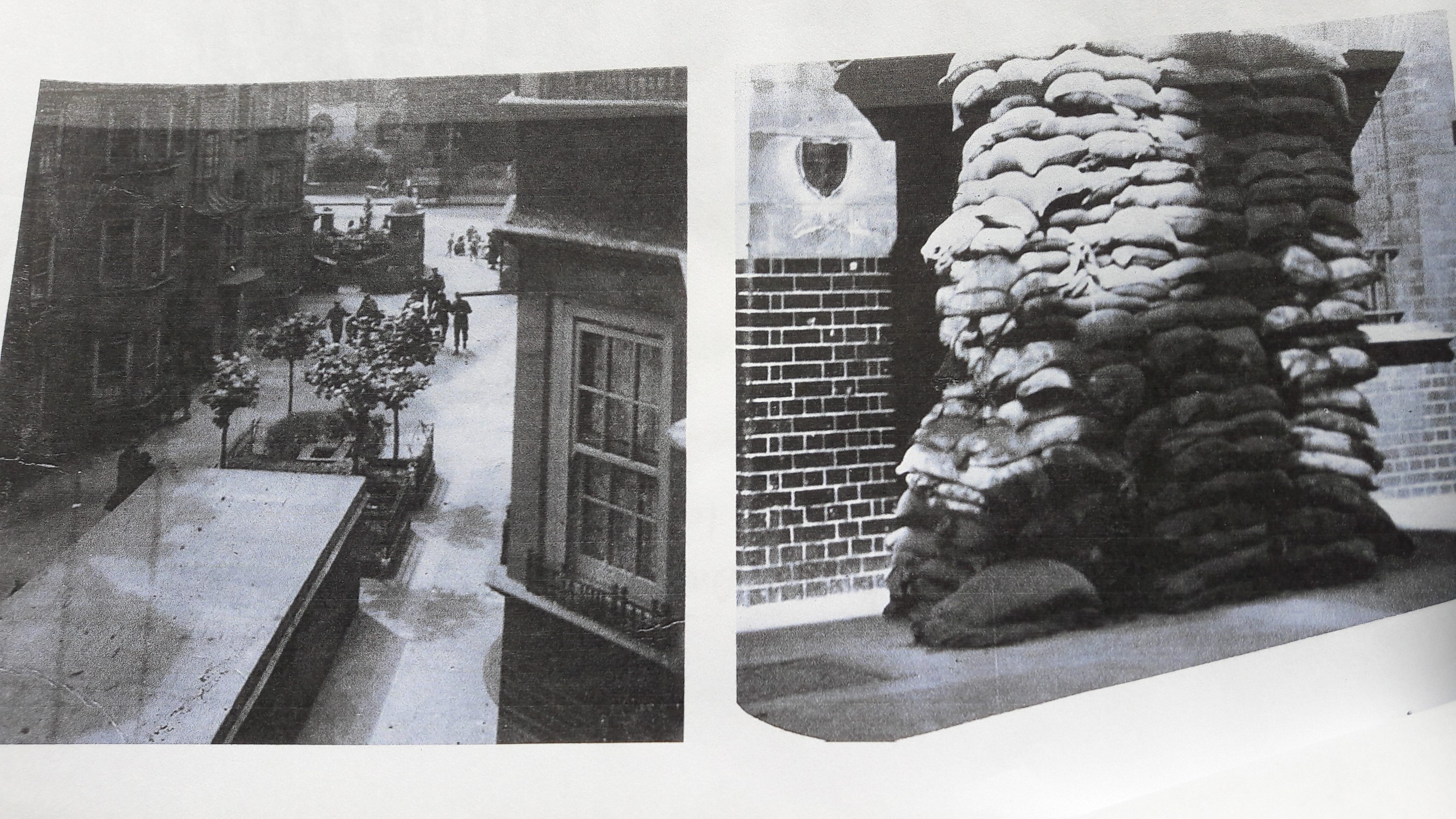
L: View from Mavis Ring’s old home in the Samuel Lewis buildings. R: Sandbags round the Samuel Lewis buildings (c) Mavis Ring/Islington Faces
War time memories – a poem by Mavis Ring
I was born in London in 1935,
four years later war broke out, so would we live and survive?
One never heard the modern day word ‘stress’ people just continued with life and did their very best
The first day I remember and do recall
when Dad came in and said ‘Come on Princess you will be late for school’
School was truly a haphazard affair
the warning would sound so we couldn’t go there
We would watch the aeroplanes filling the sky
listening to the sounds of bombs dropping close by
When the raid was over and the ‘all clear’ did sound
we would all rush out to find a piece of shrapnel on the ground
It was an eerie feeling at night-time
when showing a light was surely a crime
If a chink of light you could see
the air raid Warden would callout ‘Put that light out, 33c’.
My sisters who were older than me
were quite young ladies by 1943
Off to work they would go day by day
out in the evening to dance the night away
There were plenty of boy friends for them to choose
soldiers, sailors and RAF blues
Mum came home and said one day
‘Go round to the Town hall the Yanks have come’
my sisters came back with arms full of goodies and plenty of chewing gum.
One wouldn’t believe the war was still gong on
we would go to the pictures regardless of bombs
A ration-book was issued to all
food was sparse if there was any at all
There wasn’t the choice as there is today
but we didn’t go hungry and still found ways to play
Hopscotch, skating, whips and tops to name a few
skipping with a great big rope which we could all do.
The doodle-bug was our biggest scare
we knew it would drop but we didn’t know where
You would think my memories would be full of woe
but I have to say this is truly not so
Too young to appreciate the real life tragedy, you see
my childhood was a truly happy time to me.
Unique sleep over
One night I slept in the House of Commons. Mother’s Uncle Stan worked in there – I’m not sure what his job was – and lived in one of the flats in the arches. While we were with him there was an air raid warning. It was about tea time so my mother and grandfather went home and we were left. My father said ‘That was a daft thing to do’. I remember it so distinctly. Big Ben chiming and the big wooden doors in the bedroom, which a cat came and sat on. We were taken out on to the Palace of Westminster balcony in the evening to see bombs dropping, searchlights going, and a barrage balloon come down in flames on the Thames.

Boys living in the Samuel Lewis Buildings during WW2 91939-45). (c) Mavis Ring
What did you do for fun as a teenager?
I met my husband George dancing. We had a dance together in the barracks on Offord Road. We never went there, I think there was a special offer that day, and he said he’d never been there before either. Mainly all our dancing was done in Islington town hall or Hornsey town hall, Holborn hall and Finsbury. George said he’d walk me home when I said I lived not very far away, in the flats across the road. I joke that he only went out with me because I lived near.
We used to go ice skating and roller skating at Ally Palace – but it didn’t cost much. We could go to the pictures for one and nine pence. I only went once to the Collins music hall (where Waterstone’s is now on Islington Green) although my uncle played the piano there –to see Max Miller whose jokes were quite saucy (he was known as the Cheeky Chappie). My father was really laughing but I didn’t get the jokes at the time. And my cousin still has the gavel that the chairman had.
Our local cinema was the Highbury Picture House. Further away there was the Carlton in Essex Road, the Odeon in Upper Street, the Blue Hall on Islington Green and the very posh Savoy at the Nag’s Head with its thick red carpets, brass handrails and a beautiful flight of stairs leading to the upper circle (now the Holloway Odeon – it was hit by a V1 bomb on 8 November 1944 destroying the auditorium).
When we were at the cinema it was always possible an air raid siren would sound, and if this happened we were not able to leave until the ‘all clear’.
How did you cope without much cash?
When I was young, quite often we would have to wait until Dad came home with his wages on a Thursday before we could eat!
My father said they used to do get their father’s best suit out of the wardrobe – throw it out of the 5th floor balcony down to the boys below who’d go and porn it. That got them a few drinks in the pub and then on Saturday they’d get the suit out of the pawn shop before his father knew because he would wear it to the pub.
My husband’s father was one of eight brothers and they had to share just one suit!
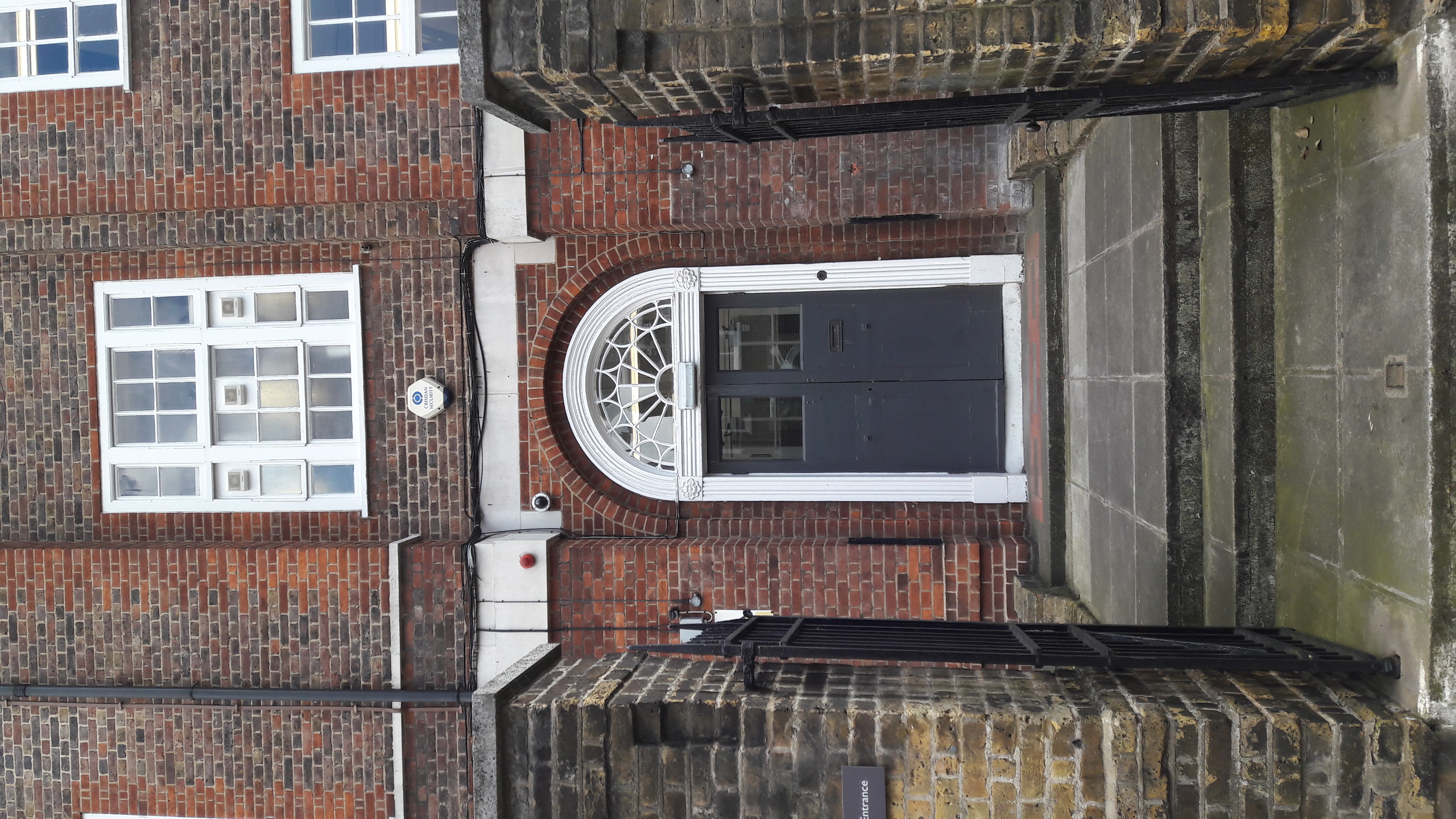
The old main entrance for Highbury Hill High School, now Highbury Fields School, see this history, http://www.highburyfields.islington.sch.uk/52/history-of-the-school (c) Islington Faces.
What was school like?
I’ve got a school photo from 1942 of our whole class at Laycock Street Primary, but looking back we hardly had any schooling, we missed so much because of the war. I still meet up with the boys I grew up with – often at Liverpool Street Station – and they’ve all done so well. David Perman is an author, another one has done extremely well in insurance and has a lovely life. Another is an architect. They’ve all done so well.
We may have missed lessons but we did have good schooling and my secondary, Highbury Hill (where I went from 1949-55) had dedicated teachers. Miss Few, who used to teach us maths is still alive, she’s 100. She’s come to the Highbury Old Girls reunion all the way from Brighton. I was so surprised because she hadn’t changed in appearance, except a bit plumper.
All the girls were introducing themselves to Miss Few – I said ‘You wouldn’t remember me, I didn’t do much in maths, I hated maths.’ She asked me who I was and then said, ‘I remember you – there was Mavis Divine, Mavis Big and Mavis Little and you were all in the netball team. Fancy her remembering that after so many years!”
Watch this 20 minute video (Our School Days, 2011) for some memories from Highbury Hill Old Girls, and others (Mavis is not in this film though).

The Samuel Lewis Buildings were built in 1903. Here’s the party celebrating 100 years of the flats in 2003. “I don’t remember a VE party,” says Mavis Ring. (c) Mavis Ring via Islington Faces
Do you miss Islington?
I live in an ordinary semi detached house in Chelmsford, Essex now. It was built in 1960, it’s quite nice. When the children were young we communicated with our neighbours, but since our children have grown up we have sort of lost touch. And when the new people move in you never see anyone. Everyone goes in and out in their car. I can go down the town and hardly see a face that you know. When we were living in Islington you’d see everybody. Adults didn’t speak a great deal in front of children. It’s not till you get much older that I think ‘I wish I’d asked my mother that’. And my children are not interested in another war story, so you can’t win. I often feel I should write a book as I have so much to tell as I have seen so much change during my lifetime.
Mavis Ring is helping contribute to the Christchurch Heritage project by sharing her memories of the V1 bomb at Highbury Corner. She’s also contributed her wartime memories to Islington Archaeology & History Society (winter 2016).
Over to you
If you’d like to nominate someone to be interviewed who grew up, lives or works in Islington, or suggest yourself, please let me know, via nicolabaird.green at gmail.com. Thank you.
If you liked this interview please SHARE and/or follow by using the R/H panel and seeing what best suits you – getting an email, joining the Facebook group or hopping on to Twitter
If you enjoyed this post you might like to look at the A-Z index, or search by interviewee’s roles or Meet Islingtonians to find friends, neighbours and inspiration. Thanks for stopping by. Nicola