Estimated reading time:10 minutes, 24 seconds
Everyone has a story. Andy Gardner, the heritage and outreach worker at Islington’s fabulous Victoriana landmark and music venue, the Union Chapel, talks about Canonbury, George Orwell’s Islington life and the Margins Project for the homeless. Interview by Nicola Baird.

Andy Gardner moved to Islington in the 1980s to study history. Now he’s Union Chapel heritage and outreach worker. Although brought up in Buckinghamshire, Andy has a long connection with Islington as his father, John, after working as a soundman on the early Dr Who episodes took a job in Islington with the ILEA (inner London Education Authority) in Laycock Street, now long since abolished. Andy Gardner: “I grew up with Tom (Baker) and have got a long multi-coloured scarf in the vestry.”
The Union Chapel, where Andy Gardner, 44, is heritage and outreach worker, is a truly beautiful building – with high vaulted ceilings, stained glass, wooden pews and a famously restored organ. “It’s a place purpose built for music,” says Andy, “and I spend a huge amount of my life in this building.”
Much of Andy’s work is with the Margins Project which offers “a proper hot meal on Sundays” to anyone who needs it – typically close to 200 people each week. “This should never be called a soup kitchen,” he explains. “We have a laundry, showers and advisers – many of whom are previous clients and understand people’s needs.”
“Official figures don’t take in sofa surfers who may not be sleeping on the street, but are technically homeless,” he explains. “And we know there is a massive shortage of council housing with the last estimate I saw being 12,000 people on the waiting list.” The Union Chapel’s Margins Project also runs coffee and craft clubs to combat loneliness – and helps people warm up or have somewhere to go. It even provides practical catering and business experience to help people into work by preparing tasty meals that are sold before A-list Union Chapel gigs.
Even during the Christmas-New Year period the Union Chapel opens its doors to those in need. The Quakers set up a Christmas Shelter there to ensure that the homeless, and anyone living on the margins had a place to go, and food to eat when many other services shut down – and have been at the chapel for eight Christmases now.

The Union Chapel has been called a Tardis. Here is one of the upstairs rooms used as the bar for shows. It was built in 1877 (on the site of the too-small chapel erected in 1806). Impressive past worshipers include Asquith (Liberal PM, 1908-1916) and the poet John Betjeman’s mother. Betjeman’s involvement helped save it from demolition in 1982. Many worshippers came from both right and left.
Inside the Union Chapel
The Union Chapel is a warren of passageways and intriguing wooden doors with signs pointing you towards the rehearsal spaces, the stage, bar and Sunday School space (another hireable room). Andy may know it well, but he likes the way: “You never know who you are going to meet here. I’ve even met Tom Jones in the corridor.” And of course he does mean THE Delilah-singing Tom Jones.
As well as the good work the chapel does practically and spiritually (with regular Sunday services) it also uses its fabulous space and the renovated organ for A-list gigs. “I can list and list the people who’ve played here,” he says moving into anorak mode. “Chrissy Hynde performed beautifully, then three-quarters of the way through she unplugged everything and performed a capella – people were in tears, it was stunningly emotional.”
Over the years performers have included U2 (before they were well known). Hugh Laurie launched his debut jazz album, Let Them Talk and the upbeat Noisettes sold out. In 2015 highlights will include a live organ performance to the back and white 1924 horror film Phantom of the Opera, Fairport Convention return again – it’s an annual occasion – and Graham Parker will appear in May. Many bands love to play this venue appealing to a wide range of music lovers’ both in taste and age. Check out the Union Chapel website here.
In many ways it’s no surprise Andy chose to have this interview sitting in the front row of the Union Chapel’s 1,250 seats as he explains that, “Architecture has always been a passion,” perhaps triggered by an early love of Lego.
“I’m anthropomorphic about buildings – when I first came into the Union Chapel I could feel this building breathing. She almost said, ‘here you are, I’ve been waiting for you’.” First he became a member of the chapel – it’s Congregationalist, which means Protestant but non-hierarchical, so no bishops etc. Not long after he began working here.

Andy Gardner leading a walking tour around Canonbury – here at the Highbury (Boer) war memorial.
Places Andy Gardner likes in Islington
- “Islington is a group of villages that bumped into each other – Finsbury, Barnsbury, Canonbury, Highbury and so on – each have their own characters and own architecture.”
- “I adore the architecture of Canonbury and love Highbury Fields too.
- This is where I’ve put my roots down – I’ve lived on the Marquess Estate for 12 years, and before that I was on the Popham Estate, but Canonbury is home.”
- “Canonbury Square is the one of the most beautiful Squares in London. It’s in two halves and I like to look from the elegant side towards the flowery end and of course that’s where Orwell’s flat was.”
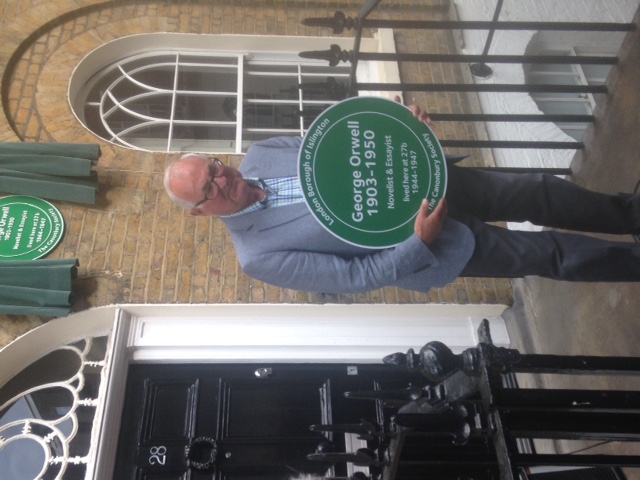
Richard Blair – George Orwell’s adopted son – back outside the house where the family lived after an absence of nearly 70 years. The plaque was put up in May 2016 with help from the Canonbury Society & Islington Council (c) P May/islington faces blog
Local history

Andy Gardner’s flyer for his George Orwell walk.
“I’ve done tours about Islington’s Jewish heritage with Petra Laidlaw, but on my own George Orwell is the one I can do without notes!”
Andy is so knowledgeable about Canonbury and Islington history that it’s fitting; he’s been chair of the Islington Archaeology & History Society since 2008. Although he lights up when talking Islington history it’s George Orwell’s time in the borough that he likes to help us imagine. On New Year’s Day 2015 he took out two George Orwell tours as a Margins Project fundraiser, spookily raising £101. “You couldn’t make it up,” he says referring to the number of the room in Nineteen Eighty-Four, where you are faced by your worst fears.
The Hen & Chickens at Highbury Corner still has the name of the old brewery, Charrington. George Orwell used to drink there and used it as a piece of his model pub in the essay Moon Under Water, while Charrington becomes a key player in his dystopian novel Nineteen Eighty-Four.
George Orwell and Islington
- George Orwell was born Eric Blair in Burma. He was schooled at Eton then spent his early professional life in the Burmese police force. He fought and was wounded in the Spanish civil war.
George Orwell lived in a flat on the top floor at 27b Canonbury Square. The plaque has the wrong date.
- He eventually settled in north London. After his house in Kilburn was damaged he moved to Islington in 1944 where he split his time between Islington and Jura until 1948 (although the plaque at 27b Canonbury Square misleads with its date).
- At the time Canonbury Square was suffering from the grim effects of World War Two bombing. Many windows were missing and boarded up; there were outside toilets in some of the blocks. It was not an elegant address.
- When Animal Farm was published in 1945, it became a must read despite being wrongly displayed in the children’s section of book stores. Sadly his first wife, Eileen, had died during an operation so missed this publishing success. Orwell was left a single dad of their adoptive son, Richard. Tragically Orwell died of TB in 1950 when Richard was only five years old.
- Andy Gardner: “Look at the Hen & Chickens and you can see the name of the old brewery, Charrington – the name of a key character in Nineteen Eighty-Four. The pub was the model for the Chestnut Tree Café too. I’m certain that Julia and Winston walk across Highbury Fields at the end of the novel.”
- During WW2 Orwell was writing essays and novels. He also produced work for Tribune and had a weekly news digest covering the Fall of Stalingrad for the BBC radio – yet to this day no one has recordings of his voice.


“I found out about George Orwell living in Islington when I saw the plaque and then heard the stories from my late friend Peter Powell (who also led walks around the borough). He was my predecessor at the Islington Archaeology and History Society and had a story for every occasion – some short, some tall.”
The funny thing about Andy is that he dresses and looks rather like his literary political hero George Orwell – both share short hair, moustache and upright posture. Orwell writes like dystopian terror tales that grip – Andy captivates on his history walks around the borough mixing how it must have felt back then with facts about who, what and where. That said I’m sure Andy has better manners: Orwell always looks so grim and allegedly slurped his tea out of the saucer at the BBC canteen…
“I’d long been an enormous fan of Orwell’s writing so to walk the streets he walked and drink a pint in the pubs where he drank is incredibly exciting – as is having such a close reading of their locations. In the Moon Under Water (Orwell’s 1946 Evening Standard piece outlining what makes the perfect pub) you can identify three Canonbury locals. The Hen & Chickens was for the interior (wooden fittings and sawdust floor with the chess board set out in the corner) and it is also the Chestnut Tree Café in Nineteen Eighty-Four. The Compton Arms is for the bar staff who know you and tell you the gossip; and The Canonbury Tavern is where the horse chestnut tree Orwell knew still stands. He liked that primarily for the garden. It was a place he could make notes and keep an eye on his adopted son Richard,” says Andy.
Andy’s talk inspired me to re-read Orwell’s novels, and some of his journalism too, including the Road to Wigan Pier and Down and Out in Paris & London. I’m certain I’ll be doing an Orwell pub crawl with any London visitors, too. Listening to Andy was a perfect New Year’s Day nudge to get to know better the many people who’ve known Islington well. And it’s an inspiration for us all to help, where possible, for the many people still living here on the margins.
One Sunday a month you can join Andy’s guided tours of the amazing Union Chapel, donations invited, http://www.unionchapel.org.uk/pages/guided_tours_of_union_chapel.html
Union Chapel gig profits go towards the Margins Project – and you get world class sound in a unique setting and the best bar in the borough, see http://www.unionchapel.org.uk
Islington Archaeology & History Society http://www.islingtonhistory.org.uk/ also see www.facebook.com/groups/islingtonhistory. If you are interested in giving a talk to the society, please contact chairman Andrew Gardner on Andy [at] islingtonhistory.org.uk
Over to you
If you’d like to nominate someone to be interviewed who grew up, lives or works in Islington, or suggest yourself, please let me know, via nicolabaird.green at gmail.com. Thank you.
If you liked this interview please SHARE on twitter or Facebook or join the Facebook group. Even better follow islingtonfacesblog.com (see menu top right) or follow me on twitter @nicolabairduk
This blog is inspired by Spitalfields Life written by the Gentle Author.
If you enjoyed this post you might like to look at the A-Z index, or search by interviewee’s roles or jobs to find friends, neighbours and inspiration. Thanks for stopping by. Nicola