Estimated reading time:9 minutes, 18 seconds
Everyone has a story. Meet a man who really loves street trees – as much for their beauty as fabulous carbon storing abilities. Chris Setz is taking his tree road show to Gillespie Park in May 2015, and has lots of clever new media ways to help map, love and value Islington’s trees. Here’s a challenge: before you read this, guess how many trees are in Islington (answer below). Interview by Nicola Baird.

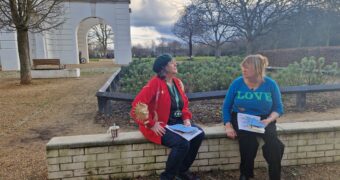
Chris Setz: “There are so many great trees in Islington it’s sort of divisive to pick out ones that you might regret your neighbourhood does not possess. Basically, all trees are wonderful, there’s no competition. Bit like a group of people living as a family – each distinct yet equally appreciated, often especially, for their different characteristics.” Photo taken in Gillespie Park, behind Arsenal tube.
Chris Setz has his eye on Islington’s trees. After a career in computing which saw him spend six years in Copenhagen Street, N1 he moved temporarily to neighbouring Crouch End and became involved in their Transition Group. He now specialises in getting north Londoners to champion their trees.
NEVER MISS AN ISLINGTON FACES: if you enjoy reading about people who live or work in Islington please follow this blog by email (see how on right hand panel). Fresh interviews are published once a week.
“We all walk past a wide variety of trees from all over the world every day,” points out Chris. “It’s easy to pass 100 street trees on your travels in a single street there and back. There may be more than 30 different species to observe in the streets near your house.”
It means that many people in Islington get the benefit of the borough’s trees every day, often without even realising it.
Chris loves trees for their beauty but he’s keen to point out that they have a monetary value too.
“Increasingly we’re putting more objective valuations on trees. A UK-derived formula (CAVAT) values one of the London Plane trees in St Mary Magdalene’s Churchyard at £1.6m – Islington’s most valuable single tree. The Elms in Gibson Square are worth around £250,000 each, whereas common trees like the cherry can vary from under £140 to over £25,000 per tree. According to the Council’s Tree Service (acknowledged by their peers as among the best of any London borough), our street trees alone are valued at more than £110 million.”
We’re getting better at estimating the real value of our trees. The open source computer movement has helped create a global tree-valuing community by providing the free, open source software suite – iTree. “One recent result has been the largest global tree survey in a city anywhere – 600 places chosen in London at random were professionally surveyed by practitioners like Islington’s Tree Officers. They work with trained amateurs to derive a more scientific view of how many and what type of trees are growing across our city. This serves to better inform local decisions as to what we should plant in our green spaces.”
Tiny Barnsbury Wood hums with birdsong and insect life. It’s one of Islington’s treasures, but only open on Tuesdays. Chris Setz reckons there are 200,000 trees in Islington – along our streets and in parks and church yards – that’s enough for each of us to look after one.
Trees to look out for in Islington… as spotted by Chris Setz
“Everyone likes fruit trees and there are many in Islington. Incidentally Alexander the Great was reputed to have been given a ‘new’ fruit whilst travelling on a mountain range between Kazakhstan and China and liked it so much he disseminated it on his travels. As a result people say that all ‘wild’ apples came from that single region. As apple seeds have been found wherever people have lived since the dawn of time it may be apocryphal but it’s a nice story, worth remembering each Apple Day. There’s certainly one single 1805 Bramley tree (named after the owner) from which the Bramley apples used in apple pies for the past 200 years are descended.The wonderful Amwell Street fig – photo taken in Feb 2015.
“Next time you’re in Amwell street, pause at the Amwell Fig – it’s the biggest fig tree I’ve ever seen. There are also quite a few olive trees growing in most wards.
“Ginkgos are really interesting as they’re ‘living fossils’ and can be traced back 270 million years – almost as long as human history.
“There are impressive trees on Islington High Street, Carlton Road, Percival Street, Kings Square Gardens, Canonbury Road and Hornsey Lane. They are also on our estates, gardens, fields, walks and parks too – they’re everywhere. Keep an eye out and use the free Tree Key to figure out what they’re called.
“My favourite trees are the London Plane trees. They are the most common street tree by far in London and are all over the borough (eg, the avenues on Highbury Fields). They’re a mix of the American and the Oriental, probably deliberately cultivated in Spain in the 17th century to arrive at their mix of characteristics. They easily shed bark so are perfect for polluted cities. The collection of mainly London plane trees in the St Mary Magdalene’s garden is my favourite group anywhere I suppose.
“There are lots of special trees in school grounds. It would be good if local children could recognise the trees at their own school.”


 Maybe it’s because I’m a Londoner
“I’ve lived most of my life in London – starting with a period in the seventies squatting in Regent’s Park, King’s Cross, Paddington, Bloomsbury and Mile End,” says Chris explaining how he knows the capital well.
“I was born in Liverpool and from when I was five through to my teenage years our large family moved backwards and forwards to Cornwall and then Devon. They were small seaside resorts, full of villagers twitching curtains so my Mum knew where I ‘d been, and who with, before I’d got home. This is one reason why it’s such a pleasure to live in London in privacy,” says Chris. But he makes an exception to his desire for anonymity when it comes to being a cheerleader for trees. “I’ve heard it said that there is no finer thing you can do than get involved with helping the place you live in improve. If you do invest in your street, keeping an eye on local trees seems an obvious step,” he adds.

Street trees on Monsell Road. New understanding of how much our trees are worth may help Londoners make the case for Greater London to become an urban national park. Find out more about this idea at greaterlondonnationalpark.org.uk.
How can I help Islington trees?
Chris recommends letting the Council know of anything you want changed/improved/dealt with during their regular maintenance in your ward. Watering trees when needed really helps them grow. “Once you’ve done the dishes you can use all that dirty ‘grey’ water to soak tree roots with through their watering hole – do this twice a week or so when they have come into leaf and especially when it’s hot. Trees really appreciate 10litre drinks”
“Trees have an abstract beauty – they can help shape our view and are almost as beautiful as the sky I think. We mostly grow up in and go on to occupy box-shaped spaces full of ‘unnatural’ straight lines. Spending time with nature’s tallest plants can provide a wonderful contrast to the geometry of the artificial world – this is probably one reason why people delight in the shape of trees.”
Chris reckons, given there are around 7 million trees in London, so there must be over 200,000 here in Islington.
“There are enough trees in Islington for everyone to adopt one. I hope to help create a map on which you’ll be able to name your nearest tree after yourself or dedicate it to someone’s memory.” he suggests. “Thanks to Google Streetview you can start identifying yours now. Using the ‘archive’ feature you can walk back in time to look at trees the way they were in the past, see how they’ve changed according to the season, grown bigger or in some cases been damaged, removed or replaced.”
 Not long ago a little booklet, The Man Who Planted Trees, was a publishing sensation – an allegory about an old man who’d planted a forest during his lifetime thanks to a habit of planting at least one acorn a day. Now it seems that city dwellers in Islington have the same opportunity to do a wonderful thing for trees – but this time, as well as simply pointing out planting sites, we can also help nature’s biggest plants better grow once there. That could mean pouring the dirty dish water into their tree pit during the growing season, helping count them or simply learning their names as a step on your journey into the treescape. Good luck!
- Make use of Islington tree wardens. Info at http://www.islington.gov.uk/services/parks-environment/parks/getting_involved/Pages/trees_guardians.aspx
- Report tree problems/issues directly to the Council’s Tree Service through ‘Report Islington’ on 0207 527 2000.
- New understanding of how much our trees are worth may help Londoners make the case for Greater London to become an urban national park, see more about this idea at greaterlondonnationalpark.org.uk.
- Chris was at Transition Highbury’s inaugural ‘Green on the Screen’ event. First film was ‘More than Honey’, an acclaimed documentary on bee decline and bee-keeping – both small scale and on an industrial scale, with hives being traded and shipped around the world to support intensive agriculture. The fewer bees, the fewer trees. Info about events can be found at http://transitionhighbury.org.uk/
- Join Chris Setz for a free tree walk organised by the Friends of Gillespie Park, starting from the Ecology Centre, on Sunday 17 May 17 @ 3pm for an hour.
- ANSWER TO THE QUESTION – HOW MANY TREES DO I LIVE NEAR?
7 million trees in London; over 200,000 here in Islington.
Words*
Transition Town is an international movement, developed by permaculture expert Rob Hopkins, which helps empower communities to develop practical responses to climate change. See more at https://www.transitionnetwork.org
Over to you
If you’d like to nominate someone to be interviewed who grew up, lives or works in Islington, or suggest yourself, please let me know, via nicolabaird.green at gmail.com. Thank you.
If you liked this interview please SHARE on twitter or Facebook or join the Facebook group. Even better follow islingtonfacesblog.com (see menu top right) or follow me on twitter @nicolabairduk
This blog is inspired by Spitalfields Life written by the Gentle Author.
If you enjoyed this post you might like to look at the A-Z index, or search by interviewee’s roles or Meet Islingtonians to find friends, neighbours and inspiration. Thanks for stopping by. Nicola