Estimated reading time:7 minutes, 45 seconds
Everyone has a story. For the next few years many people are uncovering stories of the people caught up in World War One (1914-18) – including the 9,400 men and three women from Finsbury & Islington who died. Meet Malcolm Marjoram who has been researching the 90+ men who worshipped at his local church, St Thomas’ in Finsbury Park, but died as a result of the war. Interview by Nicola Baird

Malcolm Marjoram, family and local historian: “I was brought up in chapel. Most Suffolk churches are very bare, but I like the finery and the icons at St Thomas’ Church.”
Kids may see Malcolm Marjoram with his thick white beard and say ‘oh look there’s Father Christmas’, but to Islington Faces he looks more like Charles Darwin sitting in the parish office talking about St Thomas’ history.
He plays an active role at St Thomas’ Church, N4 – opening it up in the afternoons, caring for the garden, singing with the choir, helping at services but it’s clear that research is his first love.
It’s hard to miss Blighty Cafe.
NEVER MISS AN ISLINGTON FACES: if you enjoy reading about people who live or work in Islington please follow this blog by email (see how on right hand panel). Fresh interviews are published once a week.
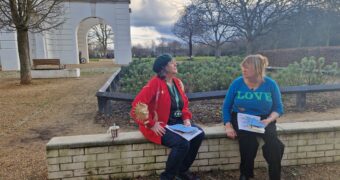
READERS ARE INVITED TO MEET UP on Monday 29 February at Blighty Cafe, 35-37 Blackstock Road, 10-11.30am

Malcolm’s full of stories about his early life in rural Suffolk, but he’s also a keen social history sleuth using people’s connection with their nearest parish to build up a picture of what it was like if you were teleported back in time.
Malcolm Marjoram’s tips to help you research family history
- Ask elderly relatives. “Of course you can ask but they don’t necessarily give answers. You couldn’t get anything out of my grandmother.”
- Root around for certificates. Often on marriage certificates the witnesses were family members.
- Don’t take anything for granted – but hunches are very useful.
- Always note down what you’ve checked, else you’ll forget and go back and try again.
- Look for original documents. So much is on line, but if it is just a mention in an index always look at the original documents. They are often different and you may find more snippets of information.
Back in 2000 Malcolm wrote a history of the Parish of Brettenham in Suffolk, where he used to live. Now he plans to write a pamphlet about St Thomas’.
He moved here five years ago. “Now I’m settled I like looking at the history of Islington – it’s an interesting place. During the time this church was being built (1888) they had to turn people away from the small temporary chapel and run extra services,” says Malcolm. “Of course houses were multiple occupied, with largish families on each floor. By the end of the 1800s there were 1,000 children on the Sunday School list.”

St Thomas the Apostle parish church – Monsell Road entrance with the dogwood in flower. The tree commemorates Ron Rose, who was well known in Islington and was a neighbourhood development officer at the time of his death in 1996. His funeral was at St Thomas’s. His widow, Anne Rose, subsequently married Malcolm Marjoram in 2010 at St Thomas’s.
At recent church open days Malcolm has shared stories about St Thomas’ building. As it is 100 years since World War One began (1914-18), he particularly likes to tell visitors about the 90 plus men who were connected to the church*, but died in active service during World War One.

This is the plaque that inspired Malcolm Marjoram to research the history of the people worshiping at St Thomas’ Finsbury Park 100 years ago. (c) islington faces
It’s a project Malcolm began after spotting the brass plaque and commemorative roodscreen around the altar. “We have a list of the men who died, but it’s becoming more difficult to trace them. They just have their initials and surnames – the plaque doesn’t even say where they served. And we can’t find anyone who is related to them,” he says. Despite this he’s found out a surprising amount.
One of those soldiers, Ernest H (Harry) Nowell is remembered as a server at the altar in a special brass plaque. He died in 1915 aged 23.
“He was home on leave, here at this church, a week before he was killed,” explains Malcolm who uses his long research career at the British Library to uncover the labours, loves and lives of the people who were living in Islington a century ago.
“Ernest’s mother brought him up,” continues Malcolm. “He joined the army as a private, got a war commission as a 2nd Lieutenant and not long after was killed in his dug out by a shell. I was surprised how young the officers (listed on the plaque) were who died, but it makes sense. They had to go over the top first, so they were the first ones shot. But not everyone was young. At least two were in their 40s and in one case a father and son.”
It’s sobering to think that on a normal 21st century Sunday around 75-85 adults worship at St Thomas’- so 90 men from the parish dying during World War 1 is “like the whole church today being killed,” says Malcolm.
There are plaques all round Islington listing men involved in World War 1 as part of the 100 year remembrance tributes for the 1914-18 conflict.
More ways to find out about World War 1 (1914-18) in Islington
Malcolm Marjoram talks in this interview about his WW1 research at one church, but as Islington (and Finsbury) was a very crowded borough when WW1 broke out there are many other places to find information.

- Crouch End Walks run by Blue Badge guides Paul and Oonagh can show you around Holloway, the home front for the Great War in North Islington. See some info about it here. They also run a walk about women and the war starting near Angel and ending on Farringdon Road by the building that was hit by a zeppelin and is fortuitously called Zeppelin Cafe.
- Islington Council has an online display about WW1, see here. They have also put up plaques around the borough commemorating born and bred Islingtonians who fought in WW1. See them at Mackenzie Road, N7; Highbury Park, N5. You can also help find out more, see how here.
- Some of the Islington soldiers who were wounded during the war, then sent home to recuperate but died are buried in Islington & St Pancras’ Cemetery in East Finchley. You can also find war graves in Abney Park cemetery (eg, sailor William Aylard who died on 23 May 1916 from the effects of gas poisoning after his battleship, HMS Russell, hit two mines off Malta). Islington Age UK, based at the Drovers Centre, N7, is working with the Commonwealth War Graves Commission (CWGC) on a Living Memory Pilot Project to encourage more people to discover and visit CWGC war graves in the British Isles to remember the war dead buried here. See www.cwgc.org

The Quadrangle at St John’s Hall, Highbury, owned by the church, was burned down in a fire.
Malcolm’s newest project is a history of the church site. “For years it was just fields, probably owned by the church as they had a lot of land around here (and a training centre for priests),” he explains. “The parish was mooted in 1877 and this church wasn’t built until 1889. Originally there was a small brick chapel at the Monsell Road end. When this was torn down to build our church the chapel was rebuilt as the parish rooms (now used by St Thomas’ Nursery as well as a polling station and for church socials).
- More info about St Thomas The Apostle, Finsbury Park can be found on the website.
- Sunday services are 8.30am, 10.30am and 6pm (please check).
- Community activities include baby & bump, tea groups and girl guides. See community info here.
- There is also a playgroup for pre-school children run every weekday morning. For info see St Thomas’ Playgroup.
Words*
90 men from the parish are recorded as having died during World War One. “they were not necessarily living in the parish. At least two had emigrated to Canada, but they were connected because their family were still living here.”
Over to you
If you’d like to nominate someone to be interviewed who grew up, lives or works in Islington, or suggest yourself, please let me know, via nicolabaird.green at gmail.com. Thank you.
If you liked this interview please SHARE on twitter or Facebook or join the Facebook group. Even better follow islingtonfacesblog.com (see menu top right) or follow me on twitter @nicolabairduk
This blog is inspired by Spitalfields Life written by the Gentle Author.
If you enjoyed this post you might like to look at the A-Z index, or search by interviewee’s roles or Meet Islingtonians to find friends, neighbours and inspiration. Thanks for stopping by. Nicola