Estimated reading time:9 minutes, 15 seconds
Everyone has a story. A writer and journalist on crime fiction and thrillers, Barry Forshaw’s first job in London was selling books at Canonbury Bookshop, 268 Upper Street, now Harvey Jones Kitchens (opposite Euphorium). Here he recalls the amazing people and places of 1970s Islington. Interview by Nicola Baird.

Barry Forshaw shares his memories of Canonbury Bookshop. ©Richard Eaton
“Every night in my dreams I find myself back in the long-gone Canonbury Bookshop. I’ve had multiple jobs working in bookshops but this is the only one I dream about. All the shelves are empty, the book spines are blank and then the staff say, ‘There are no books,’ and I say, ‘You haven’t been ordering them,’” says Barry Forshaw. This feels like the start of Daphne du Maurier’s Rebecca…
>FOLLOW ISLINGTON FACES by email: a new interview is published every week.
“It was the early 1970s, and I bought a book on where to live in London. It described Islington as a ‘neo-slum showing some signs of moving up the social scale’,” says Barry, laughing with the benefit of hindsight, when we meet at the Duke of Wellington, 119 Balls Pond Road. Despite the leery description, Barry made Islington his home knowing it had been home to playwright Joe Orton, composer Benjamin Britten and the latter’s partner, the tenor Peter Pears.
Although Canonbury Bookshop closed years ago, back in the 1970s when he was manager, it was a cultural hub. Here Barry got to meet and make friends with many of the area’s literati, such as writers Salman Rushdie (Midnight’s Children) and Douglas Adams (Hitchhiker’s Guide to the Galaxy); stage and film stars such as Bob Hoskins, Bernard Miles and “a lot of Hammer Horror actors”; and top musicians such as Simon Rattle.
Barry had grown up in Liverpool and had already had pieces printed in the Liverpool Echo. He had first been introduced to Islington thanks to Pinter’s The Caretaker, which namechecks Balls Pond Road. “I remember thinking it sounds so exotic. I didn’t realise there wouldn’t be a pond,” says Barry, who is an expert on crime and thriller fiction, with several published books including Brit Noir, British Gothic Cinema and The Man Who Left Too Soon (about Stieg Larsson, who wrote The Girl with the Dragon Tattoo).
======================

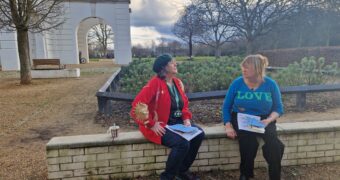
The Duke of Wellington, on the corner of Balls Pond Road and Culford Road, was where Barry Forshaw was interviewed (c) islington faces
Places Barry Forshaw likes in Islington
- When a publisher wants to take me for a meal (to encourage me to review their books), then Frederick’s in Camden Passage is the media place.
- I do a lot of walking around Islington – I always enjoy the New River Walk and Regent’s Canal (when not dodging speeding bikes).
- I’ve been to some impressive concerts at Islington Assembly Hall. Silva Screen records arrange lively concerts of film music.
- I remember when the Almeida Theatre opened and you could actually get in. I went to book a play just before it opened (it was still being renovated) – Shakespearean actor Alan Howard was doing readings from the Odyssey. I couldn’t find the box office so I went down a dusty corridor and found myself on the stage with Alan Howard in rehearsal looking quizzically at me. I was the Almeida’s first customer!
=========================

The master of suspense honoured at Alfred Hitchcock’s old studios (c) islington faces
Hitchcock
Barry also still regularly reviews crime fiction and thrillers for the national press. But it was as a columnist for Islington Gazette that he got a scoop for the paper about thriller writer Alfred Hitchcock’s studios. “I was walking by the Gainsborough Studios off New North Road. They were rundown (in part because there’d been an arson attack years before) but open because there was a special exhibition of ‘Islington’s premier film studio’ before it was converted to apartments. It wasn’t a very impressive farewell exhibition for such a celebrated film studio; there were a few pictures of Hitchcock and the Wicked Lady. Then I saw a door that said, provocatively, ‘Do not enter’. I just knew that behind that door there was a mittel-European street, with cobbles and shopfronts, that Hitchcock would have used in his films. I pushed open the door and there it was! Within a week it was gone – bulldozed for the new offices and apartments. But at least there is now a massive metal sculpture of Hitchcock as a tribute to the studio’s past.”
Perhaps because the area was cheap, many actors lived in Islington, and there was a steady flow through the doors of the Canonbury Bookshop. “Antony Sher was a regular customer. He was buying a book one day, and I said how I’d really enjoyed his Richard III at the Barbican. I’d been sitting near the front the night before and noticed he had manfully ignored blood flowing from a cut he’d received during the performance. A year later he published a book and mentioned me and the bookshop, saying that it was the first time he’d ever been recognised in public!” remembers Barry.

Getting to know gay and lesbian Islington with City & Islington Guide Association (CIGA) guide tour during Pride week. The Gill Wing cookshop, 190 Upper Street (on the left) used to be Sisterwrite, which was opposite Canonbury Books run by Barry Forshaw. (c) islington faces
Books in Islington
Canonbury Bookshop was initially a specialist shop. “My late boss, Edmund Fogden, said it had started as vaguely pornographic – discreet, in the manner of the bookshop in Conrad’s Secret Agent, with books wrapped in a brown envelope. Then it became a hard-left bookshop – a bit before its time! – quite Marxist. Then Edmund bought it and it became a general bookshop,” says Barry. There were two floors stocking around 10,000 titles, with the children’s books and art supplies down in the basement. “The clientele were largely middle class. Someone once came in and remarked scornfully ‘What a chi-chi shop’. The new Virago books sold by the bushel. Islington mums – the ‘yummy mummies’ of the day – also snapped up the latest books on childcare. At the time this was Miriam Stoppard. They’d say, ‘I’m sure I’ve totally f* up my kids,’ but they’d buy each new childcare book to remedy what the last trendy book had instructed them to do.”
“As a young bookseller there was a steady stream of interesting people – including Douglas Cleverdon who had commissioned Dylan Thomas’s Under Milk Wood for the BBC. They all had fascinating stories and I’d be plugging them for more. Douglas Adams was famously impossible about deadlines. His new book was in the Macmillan catalogue and I asked, ‘Isn’t that a pressure to deliver?’ He replied with his famous line, ‘I love the sound of deadlines as they whoosh by!’ He could get away with it… And everyone felt like a child beside him because he was so unfeasibly tall.”
Back in the 1970s there were no chain bookshops. “Over the road at 190 Upper Street (now Gill Wing gift shop) was Sisterwrite, a radical feminist bookshop. The books they stocked were chosen by committee, so when they decided not to carry certain titles, such as Bondage for Lesbians, some of the women would let me know, hoping that I’d order it for our lesbian erotica section. And that section, I have to point out, attracted only female customers!”
“There was occasional moral panic during the 1970s about what could be read,” said Barry. “One customer, who brought along his two young daughters, wanted to know if our bookshop would veto ‘immoral’ books. Another time, a policeman turned up and said he’d have to take away the Dictionary of Drugs by Richard Fisher (about the bad effects of drugs) and Aldous Huxley’s Doors of Perception. I explained that Huxley’s book was a literary classic, a celebrated work. ‘Is it about drugs?’ he asked. I agreed it was. There were 10 on the list and we stocked five or six. They were all taken away, and later returned. If they’d gone to Compendium in Camden then they would have found what they wanted in terms of pro-drug books galore! Another of our customers was the librarian who prosecuted Joe Orton. I’d seen the offending library books and said, ‘But they’re so cleverly and wittily defaced!’ It made no difference.”
Barry has an endless supply of stories, the two hours Islington Faces is with him flashes past. “When the fatwa happened, I remember Salman Rushdie saying it’ll blow over. Reporters would come into the bookshop and ask ‘Can you tell us where Salman Rushdie lives?’ I’d plead ignorance, but was tempted to say ‘It’s the house with the police cars parked outside!’”
He’s a bit of a flatterer too, claiming that “If Canonbury Books still existed you could sell a book of all the Islington Faces stories… Islingtonia, books and cards of old Islington scenes were published by the Town Hall and sold really well. I remember when the Aggie Hall (now the Business Design Centre) was renovated. We sold Wobble to Death, a Victorian detective story by Peter Lovesey, which featured the competitions at the Aggie Hall where people walked until they dropped.”
Despite the price of property here, Islington still has its writers. Barry likes to go to regular meet-ups with an Islington writers’ group, often at La Petite Auberge on Upper Street, along with Kim Newman (famous for his annual Islington summer parties almost as much as his books), one of Britain’s leading science fiction writers Paul McAuley, Red Dwarf’s Hattie Hayridge, crime writer Christopher Fowler, editor Stephen Jones, filmmaker Sean Hogan, publisher David Barraclough and the organiser of N16 writers’ group Charles Palliser, who hosts events at the Stoke Newington Bookshop.
“Thirty years ago I bought a place in King Henry’s Walk. Back then I was the youngest resident and everyone else were local Cockneys who’d lived in Islington all their lives. Now I’m one of the oldest, and the young men living here have plaid shirts and beards and work in media or banking,” says Barry, whose life has given him a front-row seat witnessing Islington’s transformation from ‘neo-slum’ to something altogether different. Surely there’s a book in that?
Over to you
If you’d like to nominate someone to be interviewed who grew up, lives or works in Islington, or suggest yourself, please let me know, via nicolabaird dot green at gmail dot com. Thanks to Judith for this suggestion.
If you enjoyed this post you might like to look at the A-Z index, or search by interviewee’s roles or Meet Islingtonians to find friends, neighbours and inspiration. Thanks for stopping by. Nicola