Estimated reading time:7 minutes, 2 seconds
Everyone has a story. Edgar Rogers works as a security officer at Islington Town Hall. You might have seen him on the front desk, or know him as one of Islington’s marriage registrars who officiate at Town Hall weddings. But Edgar’s also been a national basketball player for Zimbabwe and for many years in Africa took key roles on Zimbabwe’s Olympic Committee and Commonwealth Games Federation. Interview by Nicola Baird. Photos by Kimi Gill.
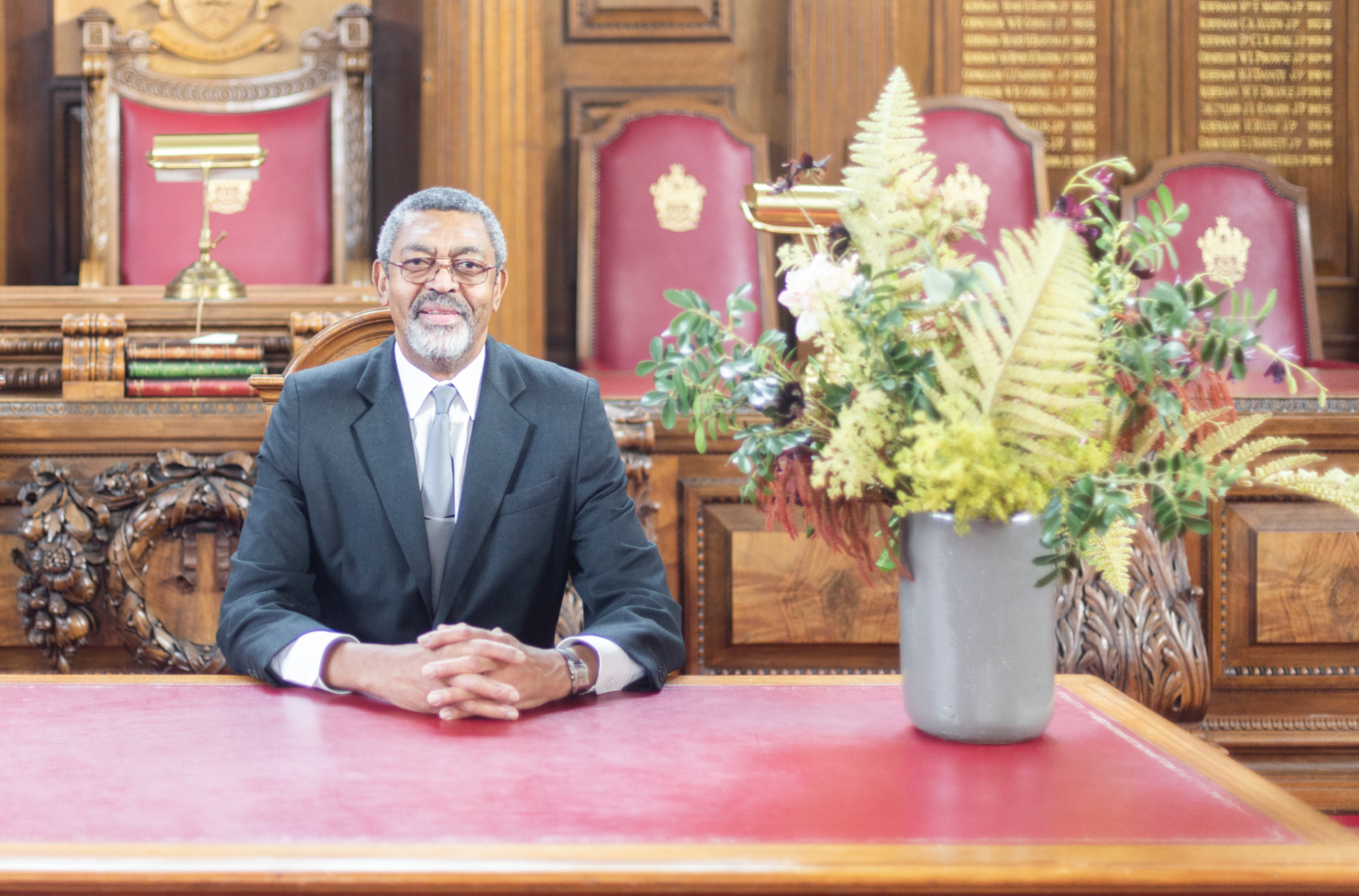
Edgar Rogers: “A wedding is always a happy occasion.” (c) Kimi Gill for Islington Faces
It’s almost as if Edgar Rogers, who is 71, has lived two totally different lives – one in Zimbabwe as an international athlete (he played centre for their basketball team). The other as a security officer on the front desk of Islington Town Hall with additional responsibilities at the weekend working as a Marriage Registrar which has led to him officiating at more than 400 marriages and civil partnerships.
FOLLOW ISLINGTON FACES a new interview is published every week. Please also come and see our free “Inspiring Islington” photography exhibition at Islington Museum from 5 April – 3 June 2019. More info on www.islingtonfacesblog.com/events
“A wedding is always a happy occasion,” says Edgar on his lunch break explaining that it is the Deputy Superintendent Registrar who conducts the ceremony while the Deputy Registrar registers the marriage in their hand writing in the Register Book – a perfect task for Edgar given his years working as a senior draughtsman in Telecoms in Harare. “My role is to explain the procedures and legal obligations and what to expect, it is also an opportunity to calm their nerves. When the married couple go out of the Town Hall there are smiles all around with passing cars hooting and people walking past stopping to admire the event.
He’s even married his own friends’ children, a real surprise for some parents who didn’t know that Edgar was in London and carrying out a new profession.
===========
Places Edgar Rogers likes in Islington
- I like having a quick breakfast of bacon and egg at the Worker’s Café, Upper Street.
- If I go out for lunch with council colleagues we like Nando’s on Upper Street or a little café on Cross Street.
- Once I was running for the bus on Upper Street and the bus driver waited. When I got there he said, “you married me!”
- My third son is an Arsenal fan. When he visited London I picked him up from the airport and the first thing he said was “Dad, I want to go to Highbury.”
- I’ve no time to play now, but I still watch a lot of sport.
===========
Apartheid years
Edgar was born in South Africa where his Zimbabwean-born father was a migrant worker. The family moved back to Zimbabwe in 1958 at the peak of the apartheid (racist) period during the forced removals. “In Port Elizabeth our area, Korsten, like District 6 in Cape Town was being demolished. It was where we all lived together. There were a few whites, Indians, people of Chinese origin and mixed but they decided to separate the races. My father was required to move to KwaZakele which was a new black area next to an established township/dumping ground called New Brighton. My mother expected to move to Schauderville for coloureds as she was mixed race. My father and mother were ballroom dancers, they were Eastern Cape champions, and were very principled and politically aware and he took the case to court. It was at that time that the ANC (African National Congress) became prominent and Mandela and all very active. I clearly remember the ANC in khaki uniforms with black berets marching through the townships talking about the struggle for freedom and a non-racial society. I was between 10- and 11-years-old at the time, remembers Edgar, so my parents decided to leave South Africa for what was then Southern Rhodesia, now Zimbabwe.
“Leaving South Africa was traumatic for me. We travelled by train through South Africa and Botswana into Zimbabwe. I spoke Afrikaans, which was my mother tongue but in Harare where we settled now it was only English and Shona that the people spoke.
Edgar’s family were in a sense forcibly removed, and for the next two decades South Africans suffered dreadfully. The Treason Trials in South Africa dragged on for four years, until 1961, when all the ANC members acquitted. But in July 1963 a raid on a farm in Rivonia led to 11 ANC leaders being charged. Nelson Mandela was found guilty of sabotage against South Africa’s apartheid government and onJune 12, 1964 he received a life sentence that led to his incarceration on Robben Island. He wasn’t released until 11 February 1990.
Violent political change was causing upset in Edgar’s new home too. At the time the country was called Southern Rhodesia, and the capital was Salisbury. From 1970 there was a civil war, until the country – under the premiership of Robert Mugabe – gained peace and official independence from Britain in April 1980. Its name was immediately changed to Zimbabwe and the capital became Harare.
African life
Edgar is tall and has always played a lot of sport. “I loved football, basketball, rugby and athletics but then I concentrated on basketball and made the national team. In 1976 the team was selected to go to South Africa and that cause a bit of a problem as there were two blacks in our team, myself and a colleague, and under apartheid South Africa that couldn’t happen! Boycotts were beginning to have an effect and already South Africa was isolated from international competition for its main sport, rugby. That year two Maori men on the All Blacks rugby touring side, known as the Going brothers (Sid and Ken) were only able to play after South Africa passed an Act in Parliament that where people were not white on a team they were considered to be honorary whites for a period. So, when our basketball team was chosen, I fell into the same category.”
“I was playing in centre and had two minds about going. But two prominent Zanu members (now Zanu PF), Edison Sithole and Nelson Mawema told me to go. They said it will open doors for others and bring about change in South Africa. And so my team mate Kimon and I went to play in South Africa as honorary whites. When we played (and beat) Northern Transvaal I had some friends in Soweto and I asked if they wanted to watch me play. They did and the authorities turned a blind eye, so I think my two dozen friends became the first multi-racial sports crowd in Pretoria! Shortly after I was interviewed on South African TV by an Afrikaans-speaking journalist. He spoke in English to me and when I answered in Afrikaans he almost dropped the microphone: he thought I was African-American,” says Edgar with a chuckle.
When he retired from playing Edgar went into sport administration. “I was involved in the Zimbabwe Olympic committee,” he says. This was no easy task as “like South Africa we were banned from international sport. I wrote to the International Basketball Federation to have ourselves reinstated.” After lobbying – which included a trip to the Moscow 1980 Olympics “we were re-admitted,” says Edgar. It was a proud moment for this sports-mad athlete representing a sports-mad country. Even when he retired from work in Zimbabwe at the turn of the century, for two years he was Chief Executive of the Zimbabwe Football Association.
Islington
So how come Edgar moved to London (he’s based in Kensal town) and works in Islington?
“My sons were at Rhodes University in South Africa, studying journalism, but the Zimbabwean dollar became worthless and university would only accept fees in foreign currency. There was no way of paying the fees. So, I had two option: my sons could leave university and come back to Zimbabwe where there were no jobs, or I could leave the country and get work elsewhere. My wife’s grandfather is from Scotland, so we obtained ancestral visa to reside in the UK. My first job was at the Town Hall in Islington.
Hopefully if you go into the council buildings often, you’ll already know Edgar well. If not, you’ve been seriously missing out. Thank you Edgar for sharing your fascinating life story with Islington Faces.