Estimated reading time:12 minutes, 6 seconds
Everyone on Islington Faces Blog has a story. “I’ve promised not to write a book until I’m 80. That way no one will be offended,” says Stephen Coles who has been vicar at St Thomas’ Finsbury Park since 1989 and a priest since 1982. So how do we find out what he thinks of the locals, how he became friends with Abu Hamza, and whether he enjoys his job? Interview by Nicola Baird (warning: this is a long interview)

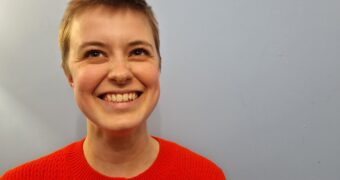
Stephen Coles: so often smiling.
Rev Stephen Coles is outspoken, controversial and fit (he trains at the Sobell gym three times a week). He’s an openly gay vicar, the only Islington member of the General Synod and well-known for being pro-women priests (at St Thomas’ the Curate – a trainee priest role – is Pauline) and anti-church schools. His church is a temple of incense, his sermons are stimulating and his congregation growing.
“The comparison between the theatre and the church is quite a natural one,” says Stephen rightly guessing my direction. “You have to have a way of presenting and to engage people. I’m sure the energy that goes into being a quiz master (eg, for Friends of Gillespie Park’s annual quiz night) or an MC (at the Gillespie Festival, on the second Sunday of September) or preaching at a service comes from the same place. A wedding is always a show, but the priest in charge is the only person who knows what’s going to happen. I always say at the start something to make people feel included. If you examine relationships at a wedding you’ll find an enormous amount – divorced, partners died, or a disappointed marriage, or gay.”
In 2005 my husband, Pete, and I were one of the four or five couples a year Stephen married at St Thomas’. Yet it was only in 2006, when civil partnerships were legalized, that he was able to marry his partner, Rashad Zeynalov.
“In 1967 I was aged 18 at Oxford (studying history) when homosexuality was decriminalized, but not for 18 year olds,” says Stephen recalling a difficult time. “It was decriminalized for 21 and over. Going on to Cambridge to do a PGCE (teacher training) meant I could be a new person and be confident about my sexuality.”
He then taught history at secondary school for three years before travelling overland to India.
Indian spirituality
“India had a lot to do with my vocation. It was 1974 and I was 25. My friend Rupert was doing crop research in India and another friend and I thought we’d go to see him. We stayed away for a year. It was the first time I’d really had the opportunity to spend time in countries not majority Christian.”
“I ran out of money after eight or nine months and then my mother said that there’d been a teachers’ pay award backdated. It was £500, enough to keep me going for four more months – though I did have to borrow my air fare to get back! I travelled to Turkey, Iran, Afghanistan and Pakistan, and then all around India and spent less than £1,500 in a year – but I rarely slummed it.”
Traveling was a big change from life ruled by the school bell. “It was very unhurried. Three or four times I took the train from Delhi to Hyderabad – that’s 33 hours. I met Moslems, Sikhs, Hindus, Zoroastrians* and found out a lot about other religions. I found as a consequence that it was possible to be a very committed Christian without saying everyone else is wrong. In India especially I met people who obviously had very good lives – talking to them enriched my Christianity and challenged it. It made me ask deeper questions.”
Stephen stayed at ashrams* including the famous one in Pondicherry, and went on a Buddhist meditation retreat in Madras. “In all the countries I went to it was perfectly normal to ask about religion. In Iran I was introduced to the first indigenous Anglican Bishop, Hassan Dehqani-Tafti,* who always talked about Islam in a positive way” (years later Hassan’s son Bahram was assassinated and Hassan came to preach at St Thomas’ about martyrdom).
One of those questions was whether to be a monk or a vicar. Another was where to study. “When I was accepted for ordination by George Timms – a short man with a loud voice – he said ‘you’re not going back to Oxford or Cambridge because you’ve been there,” says Stephen, irrepressibly warm and witty (later on in the interview Stephen can’t help himself giggling as he remembers the caring job he had for a housebound friend Clare, who needed help “after a very bad fall over her blind poodle”. At last, at 29 and a half years old he took another degree at the College of the Resurrection, Mirfield http://college.mirfield.org.uk in West Yorkshire, which included a dissertation on the dialogue between Christianity and Hindusim at ashrams* in Tiruchirapalli, South India.
He became a Deacon in 1981 and has been a priest since 1982 – with his first job at St Mary’s, Stoke Newington, which has “ two churches: Stoke Newington is a place of tremendous pretension,” says Stephen laughing.
Life at St Thomas’
But when he joined St Thomas’, it felt like home. “I know I technically live in Islington, but Finsbury Park is not Islington. This is not Highbury. Finsbury Park is a mixed and messy place – which is its strength. Middle class professionals have started falling down Highbury Hill to where the old white working class and first generation Caribbean were living, and are now beginning to retire. It’s interesting this mix of stable and movement – lots of people in the parish have been here quite a while. “
All about Abu Hamza
“When I arrived Islington had neighbourhood offices and neighbourhood forums (it’s where I met Diane Burridge). At one meeting there were some people from the mosque, when it was called the Indo-Pakistani Cultural Centre. I suggested to one, Malik, that it would be nice to get to know each other. Every six weeks we met at my house (known as The Cardinal’s Hat) for tea and biscuits. We gradually got to trust each other and could ask challenging questions that no one could take personally.”
Then there started to be trouble at the mosque every Friday. “The mosque was funded by Saudi money, and the Saudis wanted a dome, but Malik said as ‘soon as you put a dome on a mosque, people start trying to fight for power’.”
Not long after all the Algerians moved into the top of Blackstock Road and the mosque’s congregation changed again.
“There was obviously quite a power struggle,” says Stephen. “Then 9/11 happened and Abu Hamza spoke out. I had to speak to him so the Sunday after 9/11 I went to the mosque by myself and said I’ve been here a long time, and I’m anxious that what you are saying will make it harder for Muslims and Christians locally to get on together. He said ‘I beg to differ’. But I breathed a sigh of relief. I saw him once more, but we’d had two robust conversations.
Then Abu Hamza was arrested. “The Rabbi from Stamford Hill and I went along to the Old Bailey as character witnesses. I went because I refuse to demonise him. He’s a human being with whom you can have a conversation.”
The contact should have ended when Abu Hamza was sent to prison, but it ended up creating a friendship, with Stephen visiting Hamza two or three times a year for eight years, for two hours at a time. “It was the end of Ramadan, a time when I send cards to the Muslims I know. I decided to send one to Hamza in Belmarsh High Security Prison and I knew he was vulnerable as he has one eye and no hands. I think it is vital he’s treated well as a human being – so he can’t make any suggestions that he has not been treated impeccably. I got a reply by return saying he’d very much like to see me. It took a year to see him as I had to get MI6 security clearance.
“The first visit was in 2004, and we talked about all kinds of things. His lawyer and I assumed he’d know about my sexuality (Hamza has strong homophobia), but we didn’t talk about it. I wanted to show that whatever he said I just was going to treat him as another human being. It was taking loving your enemy seriously.
In 2013 Abu Hamza was extradited to the US on terrorism charges (including taking 16 hostages in the Yemen in 1998 and advocating violent jihad in Afghanistan in 2001 and conspiring to set up a jihad training centre in Oregon, US). “I don’t even know where he is, and I’m very concerned about him,” explains Stephen. “He’s in isolation in an American prison [awaiting trial] and will be in prison for the rest of his life. I’m waiting for the new American ambassador and then I’ll send a letter asking if I can keep in touch. I’m imagining letters.”
More tea vicar? Some questions for Stephen Coles
Q: Where would Jesus live in Islington?
“Where it would most challenge us? He’d sleep on the steps of the town hall.”Q: What’s wrong with church schools?
“I sometimes talk about a child in a church school being impoverished. At Gillespie Primary they will be sitting next door to a Muslim child. They’ll learn what it’s like being brought up as a Muslim.”Q: Do you know your area?
The church is in two postal districts, N4 and N5. Part of my work is being in N4. I’m a lazy cook but I shop locally, I like eating in restaurants in Blackstock Road, but go to different onesQ: Is your congregation growing?
Given the fecundity of the water the birth rate is high locallyQ: Do you still have good links with the mosques?
Yes, but there are two full time Imams missing at Finsbury Park – the North London Central Mosque and Muslim Welfare House. I hear the problem is finding people who speak English fluently; are properly trained (Abu Hamza was a nightclub bouncer brought in to keep the peace) and they must understand the context – what it’s like to live in London now.Q: Do people lie to you?
“If I’m asked to read the banns (give notice of an upcoming marriage) it’s very unusual if the people have got separate addresses. And if they do I suspect they are telling me a half truth because they are slightly frightened to tell the vicar.”
Passing on and parking vouchers
If weddings are rare for Stephen, funerals “are quite unusual because unless someone asks for the local CofE priest the funeral director* makes all the arrangements. I do half a dozen a year, and there is a burial and cremation rota for the local clergy to take the funeral and can then pass on any pastoral needs to the parish priest/vicar. Islington has good bereavement services – Rucksack for kids and CARIS, which was established by the churches. After the Marchioness sank on the Thames (in 1989) CARIS was asked to help with counseling of surviors and bereaved.
“A crematorium is only about death,” says Stephen, “but church has other associations.” However some people were put off funerals at St Thomas’ because of… parking problems.
Stephen explains: “Because the church isn’t a home or a business it is not allowed parking vouchers. I pointed out to the Council that Islington’s only crematorium is at East Finchley, and is virtually inaccessible by public transport. There’s no way, in the time available, to get to these places except by car. But, the last thing a parking attendant wants to do is give a parking ticket to someone at a funeral! So Islington council changed their mind and now lets us have permits.”
Stephen has also had the foresight to allow ashes to be interred in the church garden, and added a couple of benches to enable anyone to make a contemplative visit. It’s another example of his thoughtfulness. Church is very live for many people, for some it’s just for the big events, Christmas and Easter, or a venue for those just hatched, matched, or to be dispatched. Whatever way your spirituality takes you there’s no doubt that our campaigning and outspoken priest, Stephen Coles, is an impressive community resource. Finsbury Park is lucky to have him.
- St Thomas’ the Apostle, Finsbury Park (built 1889), on the corner of Monsell and St Thomas’ Road. Parish communion on Sundays at 10.30am. Holy communion on Wednesdays at 7pm. http://www.stthomaschurch.co.uk
- CARIS Islington Bereavement Service, www.carisislington.org, 020 7281 5200
- Rucksack – supports bereaved children in Islington, contact numbers as above.
WORDS*
Ashram – a contemplative retreat. For instance the ashram at Pondicherry, http://www.sriaurobindoashram.org . Also see more about the late Bede Griffiths at http://www.bedegriffiths.com/ashrams/
Bishop Hassan Dehqani-Tafti – was Bishop from 1961-1990. He survived an assignation attempt, and saw his son murdered. The last 10 years of his ministry were spent in exile. See obituary here http://www.telegraph.co.uk/news/obituaries/1918728/The-Rt-Rev-Hassan-Dehqani-Tafti.html.
Zoroastrianism – is an ancient Iranian religion and religious philosophy, see more. http://en.wikipedia.org/wiki/Zoroastrianism
Islington funeral directors – the three main companies Stephen Coles works with are:
- Co-operative Funeral Service, http://www.co-operative.coop/funeralcare/ at 187 Holloway Road
- Dignity (through John Seaward at 163 Stroud Green Road http://www.dignityfunerals.co.uk/index.asp?pageid=18&fd=112 )
- Millers, 93-95 Essex Road http://www.wgmillerfuneraldirectors.co.uk
Over to you
If you’d like to feature on this blog, or make a suggestion about anyone who grew up, lives or works in Islington please let me know, via nicolabaird.green@gmail.com. Thank you.
If you liked this interview please SHARE on twitter or Facebook. Even better follow islingtonfacesblog.com (see menu top right).
This blog is inspired by Spitalfields Life written by the Gentle Author.
If you enjoyed this post you might enjoy the most popular of all islingtonfacesblog posts, Nina Marcangelo from Alfredo’s Cafe on Essex Road which had 800 viewers in a week, 187 views on its 2nd day up and 97 facebook shares.