Estimated reading time:8 minutes, 15 seconds
Everybody has a story. A professional writer, editor and translator, Andrew Wilson – originally from Canada – has settled in N19. In between work gigs he is sharing his love of history and theatre with Islingtonians of all ages. Interview by Nicola Baird. Photos by Kimi Gill.

Andrew Wilson uses music and song to share local history with school students. (c) Kimi Gill for Islington Faces
“I love to teach song writing using local history,” says Andrew Wilson, sitting in his conservatory. We’re just a few strides from Holloway Road but his home seems a peaceful spot.
This street is amazing: near the top of the row of terraced houses there’s an orange tree, laden with green and orange fruit, and all the houses have an impish looking plaster face above the doorway (possibly the builder himself, but more likely the result of a job-lot of plaster casts the builder got cheaply). It’s friendly too: there’s a regular street party for which Andrew once organized a performance of “Old Macdonald had a Band”, with neighbouring kids playing everything from tin whistles to tubas. As well as guitar, his main instrument, Andrew plays mandolin and flute, and is learning to play the bodhrán (Irish drum).
FOLLOW ISLINGTON FACES a new interview is published every week.
Andrew grew up in Canada. After a BA in History, followed by an MA in Public Administration, he worked as a civil servant until he could stand it no more. “I then went to Central America with CUSO, the Canadian equivalent of VSO – Voluntary Service Overseas – and stayed there for three years.” This experience set him off on a very different professional route. Decades on, he’s a technical writer predominantly working for the World Health Organization and other UN agencies, with his most recent publications focusing on child and maternal health. “The countries with the highest rates of mother and newborn deaths are those beset by conflict,” he notes. “Babies and mothers die when they really shouldn’t – because of the fighting, because they can’t get to a clinic, or the clinic has a power outage, or there’s no pain management…, Or because the local doctors, nurses and other skilled professionals have come to the UK and US to find better salaries, working conditions, and peace.”
Andrew is clearly happy as an expat. In fact, he only ended up in Islington in 2001 thanks to meeting his wife, a BBC journalist, while he was based in Geneva. “I married North London,” he says.
===========
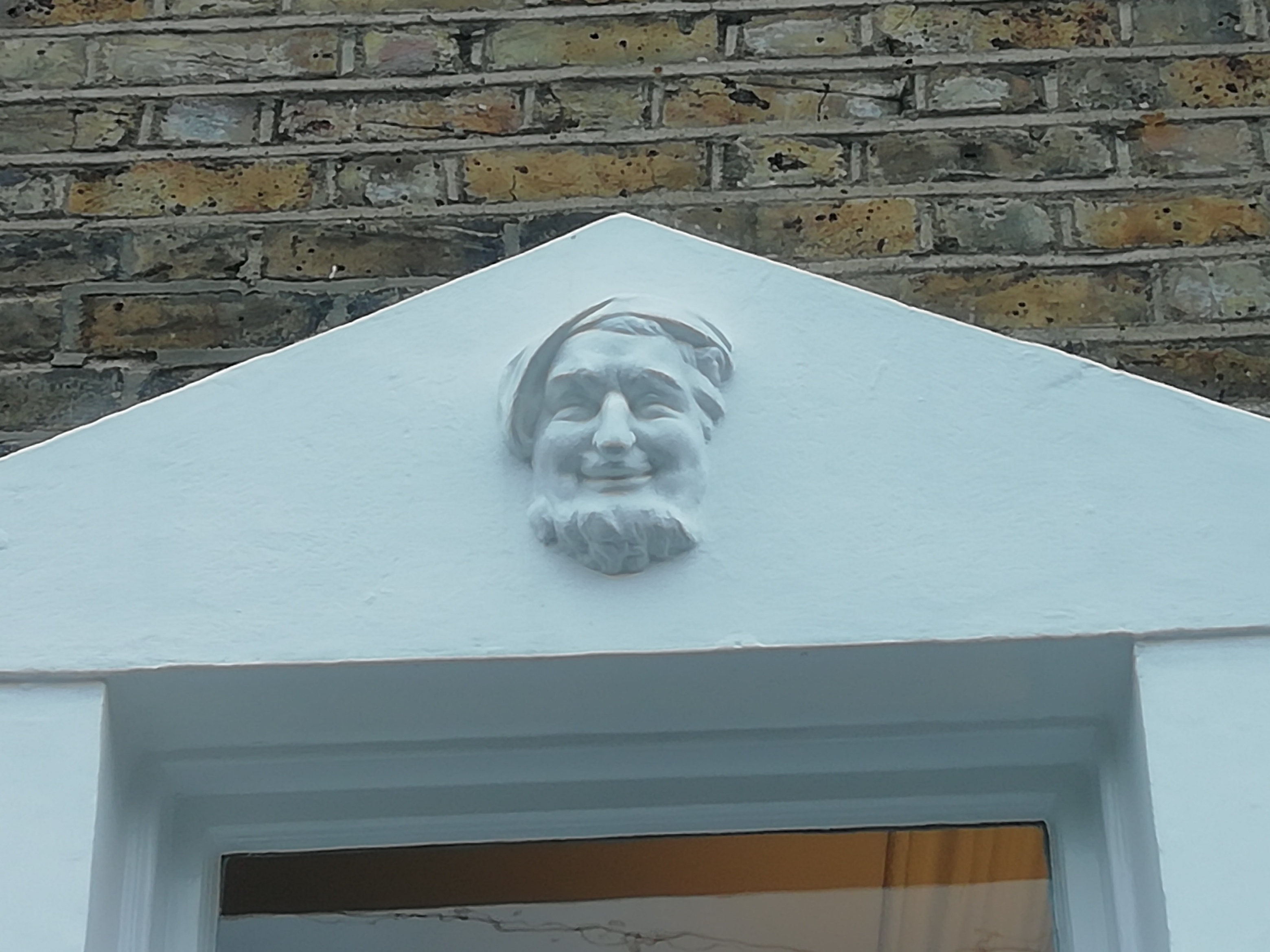
Just off Holloway Road there is a street overlooked by men in hats – possibly a portrait of the builder (c) Andrew Wilson
Places Andrew Wilson likes in Islington
- I’m a supporter of the Park Theatre, where I’m going to see Sidney and the Old Girl with Miriam Margolis in November. I sometimes write for the theatre’s blog, but my Park Theatre high point came in 2017 when Ian McKellen, aged 78, did 11 fundraising performances in nine days raising £250,000 for the theatre. I wrote the programme notes and got the chance to interview him at his home in Limehouse. He was very friendly and had a wicked way with theatre gossip.
- 500 (or Cinquecento as Andrew calls it) at 782 Holloway Road, near Archway does a delightful crab stack on flat bread and is one of the few places you can get nicely done rabbit.
- I’m Jewish but have a soft spot for St George’s Church Tufnell Park, the one where people vote. The building is ugly and quite big, but it’s got a really good feeling and all sorts of people come in. Rev Alexandra has hosted meetings there about finding new uses for the nearby Holloway Prison, which is so important for the local community.
- There’s a lot of live music around. The Landseer Arms, 37 Landseer Road occasionally has blue grass and the Owl and the Hitchhiker, 471 Holloway Road has musical evenings. Nambucca, 596 Holloway Road had Balkan music recently, in addition to their usual lineup of rock and pop.
- I like Holloway Road, not least because of its 1,500 years of history. The Year 9s at Highbury Grove school wrote some lovely songs about it, from the Peasant Revolt burning of Highbury Manor in 1391 to the V1 missile strikes in 1944 – and even a song about the Holloway kebab shops today.
================

Multi-talented Andrew Wilson, here on a mandolin, often punctuates his conversation with the exact right phrase, sourced from a different language, has also helped translate and edit a book by former El Salvador political prisoner, Ana Margarita Gasteazoro. (c) Kimi Gill for Islington Faces
He has thrived here. In addition to his technical writing, he was a magistrate at Highbury Corner for nine years. There he developed strong views about the state of the criminal justice system, particularly its inability to deal with the mental health issues that plague so many people who come before the courts. He has since become a member of the Reclaim Holloway activist group, advocating for the site of the former Holloway women’s prison to be used for social good rather than private profit.
A paid-up member of the Islington History Society, Andrew has recently sparked a historian-in-residence project based on his belief in the benefits of schools working with real historians.
“The mindset of history as a discipline is really important for children,” he says. “History asks epistemological questions: how do we know what we know? For a historian, a fact isn’t a fact: it’s a question. For example, it’s not the date that King Henry died that’s interesting, it’s how do we know that. What’s the source? What’s the evidence? What did he die of?” He’s on a roll now as he explains, “History encourages critical thinking, which is as important for children as good hygiene, anti-bullying, and financial sense.”
The idea of a historian-in-residence at primary school level came up while Andrew was teaching his Songs of Place course with Year 6 at Gillespie Primary School earlier this year. “My method is simple. With each Songs of Place project, I do some historical research about the school and the streets around it, and that becomes the ‘raw material’ for song writing,” he explains. “As it happens, Gillespie’s head teacher, Mark Owen is a bit of a history buff, and the school has a lot of history. It was built in 1879. You go in and look up and can see old gas fittings, and lots of other original features that are still visible. Then there are two staircases – why? To separate the girls from the boys, as was the practice in those days.”

Andrew Wilson is a member of Islington History Society, and keen to help schools have their own historian-in-residence (c) Kimi Gill for Islington Faces
“I did a bit of digging,” he adds, “and found that the London Metropolitan Archives in Clerkenwell have got a bunch of school assessments for Gillespie from 1880-1959. It’s very complete for the first 25 years, revealing a huge amount of social history.” From this material, he created some presentations for the students, emphasizing interesting stories that contrast with the present day.
The kids enjoyed learning about their school, and working with Andrew and their regular music teacher, they wrote several songs over the chorus of the term.
One weaves historical facts about the school when it opened in 1879, creating a lively song with the chorus:
Two stairwells
Three floors
14 teachers, and
A thousand kids or more.
It’s all true, but these days Gillespie has around 20 staff working with 240 students. “The kids couldn’t believe what it must have been like then,” says Andrew.
Another song introduced the students to their own hidden river. “Hackney Brook starts in Upper Holloway, runs under the school, and emerges again in Clissold Park,” Andrew explains. “There are some sketches from the 1700s of people fishing for trout from a tavern nearby, when the brook was still above ground. But by 1900 Hackney Brook was an open sewer running down Gillespie Road, and so was finally buried in concrete conduits. We created a liberation song for the brook.” The song ends with a rousing:
Smash the concrete!
Turn the key!
And let our Hackney Brook run free!
Andrew also told the kids about the huge factory on Gillespie Road which employed 400 people locally from the 1890s to the 1960s, and is still remembered as Stephens’ Ink Company. “From that we wrote a song called The Ink that Ended the First World War, because it’s believed that the Treaty of Versailles (1919) was signed with ink made at this factory,” says Andrew.
In previous years, Andrew has run similar workshops with students at Highbury Grove and New North Academy. Now he’s delighted that local Islington guide and Islington Museum volunteer, Susan Hahn has just started a stint as Gillespie historian-in-residence aiming to make the past come alive (metaphorically) and help develop critical thinking.
It was Islington Faces’ friend Dorothy who’d suggested interviewing Andrew. And what a good call: Andrew’s story-songs of old Islington and thoughts about the positive impact historical knowledge can have on the latest generation growing up here are definitely echoed by Islington Faces. Here’s hoping you enjoyed them too.
Over to you
If you’d like to nominate someone to be interviewed who grew up, lives or works in Islington, or suggest yourself, please let me know, via nicolabaird dot green at gmail dot com. If you enjoyed this post you might like to look at the A-Z index, or search by interviewee’s roles or Meet Islingtonians to find friends, neighbours and inspiration. Thanks for stopping by. Nicola