Estimated reading time:7 minutes, 34 seconds
Everyone has a story. Here’s how you can take a free tour of Islington’s N7 landmark – the Caledonian Clock Tower, a Grade II* listed building recently restored with Heritage Lottery funding. It’s a chance to explore the history of this dominating tower and Cally Park, one-time home to London’s biggest livestock market, with guides from Islington Guided Walks. Interview by Nicola Baird.
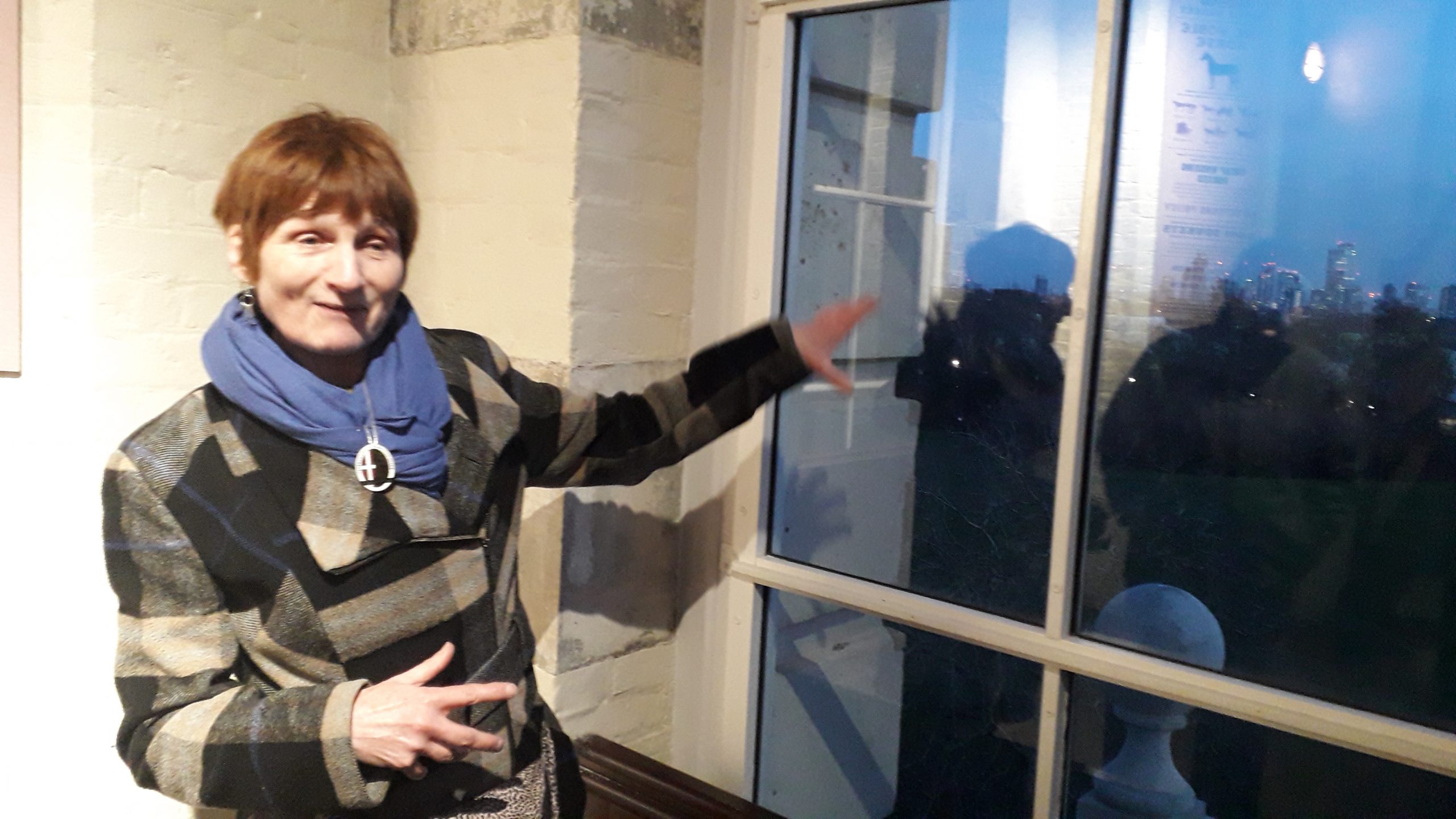
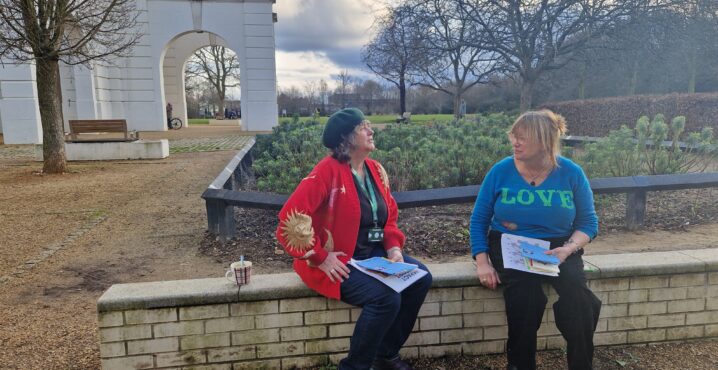
Islington Guided Walks’ Karen Lansdown explains all about the Caledonian Clock Tower and massive Metropolitan Market which used to be held where Caledonian Park is now (c) Islington Faces
Caledonian Clock Tower, on the north side of Caldeonian Park, sandwiched between Market Road and North Road is one of Islington’s splendours. It’s 46m high, deliberately built so tall to help the animal drovers coming into London locate the livestock market.
FOLLOW ISLINGTON FACES a new interview is published every week. The Inspiring Islington exhibition with beautiful portraits by Kimi Gill is currently at Space 4, 113 Fonthill Road, Finsbury Park, N4.
Most visitors will want to know just how this livestock market ended up being sited here? And where has it gone?
The answers form some of the information Islington Guided Walks tour leaders share during a new, free (but you must book) hour-long tour – in fact they offer three history tours every Saturday (next is on 21 Dec 2019). The tour is a bit of a thrill: and only suitable if you are fit enough to climb stairs, and don’t have problems with heights. Actually, the many stairs aren’t too exhausting, just a ladder-length flight between each floor, and then a chance to catch your breath or take in the views as the other visitors pad up (or down). And on each new floor the guides provide detailed info about the long-ago Metropolitan Meat Market that was held here from 1855 onwards. Even so the stairs are a fun challenge, as you climb the steep wooden stairs with their one pole, one rope banister you can always imagining your guest turn on I’m A Celebrity Get Me Out of Here.

It also becomes clear how the Age UK Islington Drovers centre got its name on North Road and how the link road from the Cally over to King’s Cross, passing the tennis courts and football pitches, is named Market Road. (c) Islington Faces
As a treat I booked a Saturday 4pm tour knowing that I’d get to see the lights of London from the very top. And it’s absolutely true: from the balustraded viewing deck at the top of Caledonian Clock Tower you can see the world with Islington goggles – to your south it’s Canary Wharf, the City and St Paul’s (once the tallest building on this skyline) then the Post Office tower. To the north you’re looking beyond Hampstead Heath and Ally Pally towards Hertfordshire’s hills.
In 1852 a decision was made to close down Smithfield’s livestock market as it was just too big and busy to be on the edge of the City. Three years later, in 1855, the clock tower was up and the Central Metropolitan cattle market had a new home, not far from the trains of King’s Cross.
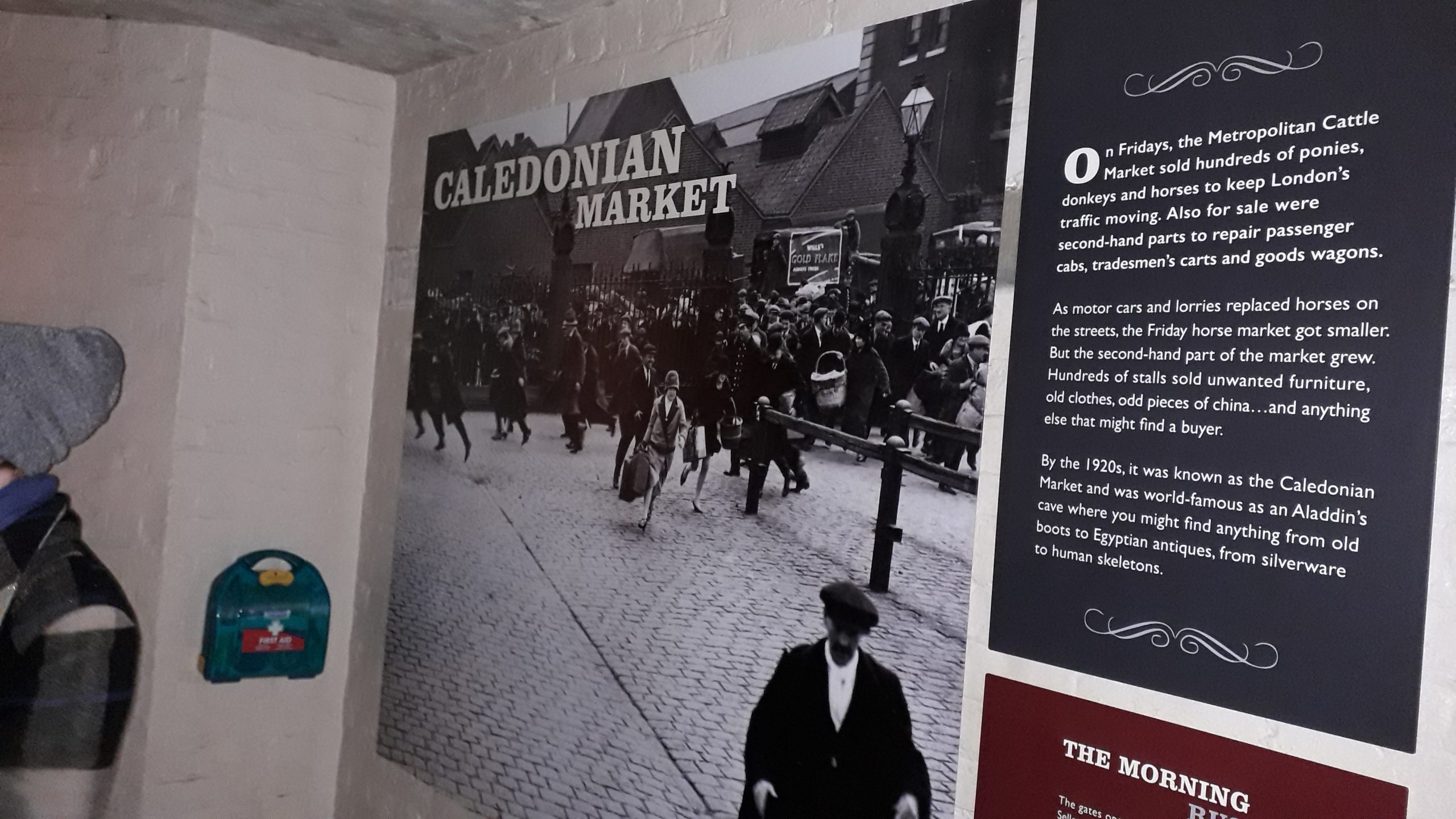
Join a free tour of Caledonian Clock Tower run by Islington Guided Walks. (c) Islington Faces
The site was already a sizeable green space, known as Copenhagen Fields after the old Copenhagen House which was a popular pub/pleasure gardens. On 21 April 1834 it’s also where a huge crowd of 100,000 gathered in support of the Tolpuddle Martyrs, six Devon farm workers created a Trade Union while asking for fairer pay which led to them being transported to Australia for seven years. No doubt the authorities figured that building a market on this spot would prevent such a big dissenting crowd gathering again. The story from the village of Tolpuddle’s angle (which has a museum) is here.
Mondays and Thursdays were livestock sales where 15,000 animals could change hands. Some would have walked many miles, maybe even from Yorkshire, so there were layers (pens) where 7,000 cattle could rest and fatten up on the spot where now there are astropitches in constant use by footballers. On the west side the layers were used by up to 42,000 sheep, pigs and poultry.
Fridays were the horse sales where you’d find “cheap working” horses and also donkeys.

The handy sheep: an info board that you can see on a free tour of Caledonian Clock Tower. (c) Islington Faces
Full use was made of these slaughtered animals. There was space for 35,000 sheep – 1.8 million annually – that would become steaks, chops, joints and legs. Wool was pressed into felt. Horns became knife handles. Guts became violin strings. Stomachs became dog food. Skins were scraped into parchment. Fat was rendered to be used industrially.
There were two slaughterhouses, which didn’t shut until around 1964. On Islington Faces you can read this interview with David Hammond who talks about visiting the pens with his mum to see the animals (although she sweetly didn’t mention why they were there).
There were also four pubs on the corners of the current grassy park footprint. On the south east corner on Market Road was the White Horse pub (now converted into flats), the south west corner’s Black Bull has long gone. On the north west the Lion is now a fancy-looking pub conversion and to the north east the Lamb is dilapidated. There were also hotels and at the base of the clock tower a range of admin buildings, toilets and a bank. It must have been such a busy place.
Islington Faces interviewee Joe Hagland also has some good stories about the area in the 1950s, see here

Islington Guides on the spiral staircase: Karen Lansdown, Jiff Bayliss, Oonagh Gay. Every Saturday they offer three free history tours of the newly renovated – by the Heritage Lottery Fund – clock tower and Caledonian Park. (c) islington faces
As it’s a clock tower, the guides – on Islington Faces’ trip these were Karen Lansdown, Jiff Bayliss and Oonagh Gay – also provide quite some detail about the clock’s mechanisms. Our Cally Clock Tower was built to be the biggest turret clock in England. It was made nearby by John Moore & Sons who were based in Clerkenwell, which for a while was theplace for clocks. The clock operates via a pulley system which means that the weights need to fall (slowly) down the tower, ready to be wound up each week. On one of the higher floors it’s very clear that the clock has four faces (the only place you can see all four at once).

Islington Guided Walks guides help you explore the Caledonian Clock Tower and see how the stairs, masonry, iron work and clock have been repaired and cleaned up. (c) Islington Faces
For those people outside looking up at the four clock faces, even if you couldn’t tell the time you’d know when trading began and ended because the biggest bell – made in the Whitechapel foundry – at the very top of the tower was rung.
In 1906 Caledonian Road tube opened and the flea market grew to the point where there were 2,000 stalls bringing in 100,000 visitors to the “world famous Caldeonian market”. The famous founder of Tesco, Jack Cohen, did his first trading here. The start of WW2 in 1939 saw the market close down; bomb damage did the rest. Post war the flea market moved to Bermondsey, where you can still search for a bargain. And there are stalls at Camden.
It’s a pleasure imagining the bustle of the area on market day and all the characters you could have met. There are stories about Greta Garbo visiting, rare black pearls being mis-sold for a bargain basement price as plain black beads, Dickens wading through excrement, Darwin buying finches… What would you have been bought?
- Do go and visit. You can book a free tour via Eventbrite here on Saturday 21 December, but more are planned during 2020 so pop back and look, https://www.eventbrite.co.uk/e/clock-tower-tours-tickets-52860524251?aff=ebdssbdestsearch
- More info about Cally Park and the clock tower on this excellent website, see https://callypark.london/enjoy-the-view/
- More info: a lovely blog post from A London Inheritance https://alondoninheritance.com/londonvistas/climbing-the-caledonian-park-clock-tower/
- Discover the secrets of Clerkenwell and Islington with Islington Guided Walks. Twitter @islingtonwalks Facebook /islingtonwalks
Insta @islingtonwalks www.islingtonguidedwalks.com
Over to you
If you’d like to nominate someone to be interviewed who grew up, lives or works in Islington, or suggest yourself, please let me know, via nicolabaird dot green at gmail dot com. If you enjoyed this post you might like to look at the A-Z index, or search by interviewee’s roles or Meet Islingtonians to find friends, neighbours and inspiration. Thanks for stopping by. Nicola