Estimated reading time:8 minutes, 55 seconds
Everyone has a story. What’s it like living in the almshouse at the Charterhouse in EC1? Brother Mike Lawlor reveals all from selection to surviving lockdown in the walled garden, plus shopping trips up to the Angel. Interview by Nicola Baird
- This is the first of three interviews on Islington Faces about life at the Charterhouse today. Also read about another Brother, Brian Reeve and Director of Operations Tom Foakes. More info at https://thecharterhouse.org/

Mike Lawlor is one of the Brothers living at the Charterhouse – this means he lives in the almshouses there (c) © Miko Malkowski the Charterhouse
Before Mike Lawlor, now 69, applied to be a Brother at the Charterhouse, he’d never heard of this one-time monastery, grand Tudor mansion, boys’ school and to this day almshouse in EC1. In fact, even Islingtonians can be a bit vague about this amazing building, just off Charterhouse Square between the Barbican and Smithfield Market.
FOLLOW ISLINGTON FACES a new interview is published every week. Everyone has an energy story series will start this spring.
Originally from Pembrokeshire, Mike had spent a lifetime teaching but was worrying about how he could afford to stay in London when he retired. Sharing this fears with his friend – an Anglican nun in Oxford, who had been a dancer at Sadler’s Wells – she said, “My brother lived in the Charterhouse and he’s a retired priest, so if they won’t take someone like you then they might as well as pack up!” Mike is chuckling as he tells this story. Of course, his friend was right. So long as you’ve worked for the public good, are 60 or older and have a housing problem then you might be in for a chance to become a Brother (there are currently three women).
You can see more about the almshouses at the Charterhouse on this short film, here
The almshouse accommodates more than 40 Brothers thanks to Sir Thomas Sutton who left a legacy in 1611 “for elderly men who had fallen on hard times”. Five centuries later the almshouse is still in operation. It also has a lovely tradition of ensuring the Brothers are part of a community, so they have shared activities, mealtimes and opportunities to show the public around this historical building. To qualify as a Brother, potential applicants, now both men and women, need to be single, older than 60, in financial, housing and social need, have no significant debts (eg, credit cards and loans), able to live independently and in good physical and mental health for at least the next two years, keen to contribute to a community and have the right to live in the UK. Pets cannot be brought to the Charterhouse.
Mike’s career was spent teaching modern languages at first in, “expensive boarding schools, then I went to Oman and Dubai and Qatar to teach in international schools.” But on returning to the UK he decided to “teach at the hard end, doing supply teaching in inner London comprehensives, which led me to going to a unit of children with emotional and behaviour issues. The staff looked at me and said,’ Most supply teachers don’t last till lunch time’. I stayed till I retired. I found the problem was not the children: it was the management!”
Mike joined as a Brother in 2015. But it wasn’t until 2017 when the Charterhouse opened its doors properly to the public – for the first time since its foundation in 1348.
“At the Charterhouse, having spent my life in front of people performing, I try and do the foreign language tours, as I speak French and Spanish. I have good memories of doing tours with a group from the Thomas More Society in Paris who presented us with a bust, another group from the French embassy and a tour of French school children from a disadvantaged area in Paris. For those students there was no point blitzing them with figures, instead when I took them into the Great Chamber I asked them what they saw. They saw a dog – which is a talbot, a hunting dog, in Thomas Sutton’s armorial arms. It gave me an insight into how to do a more merciful tour… Some people want a very learned tour, but that wasn’t what the lycée students wanted.
“I haven’t seen the Charterhouse ghost, but I’ve felt him/her. On one of my interview days you come to lunch and meet people for coffee and drinks. The Clerk to the Brothers left me in the old library, it’s a very ancient place. Off it is one of the cloisters of the old monastery. No one else was there, then someone tapped me on the back quite firmly. I turned round, but saw no one and I did not feel scared. I talked to the vicar of the parish where I’m a church warden, he said, ‘All I can say is that it didn’t mean you any harm. Since I’ve come to live here, I’ve felt very peaceful. It was only after I was accepted that I told the Governors, and no one was a bit surprised.”
======================
Places Mike Lawlor likes in Islington
I came here from a one-bed flat in Teddington. People who live in west London think north London is the end of the world. I thought the same, Islington, it’s never going to be nice, but I’m so pleasantly surprised by how extremely at ease I feel living here. Islington is rather like a village magnified. Not only is it a rainbow of nations, but it’s also symbolic of people living together in urban conurbations, the opposite of Brexit!
- Exmouth Market – really lovely. Reminds me of European streets, as if the weather was better you can sit out in front of Gail’s Bakery at 33-35 Exmouth Market. And right in middle at 24 Exmouth Market there’s an Italianate looking church, Our Most Holy Redeemer – such a great position for outreach.
- At risk of being seen as a serial shopper I do like Camden Passage. It has a similar atmosphere to laid back Exmouth Market, but is even more urban and aggressively chic.
- Islington Green can look like a tatty park, but after lockdown ended and the Brothers were let out, I enjoyed sitting at a bench there to see the world pass by, and there’s an enterprising man who sells coffee from his Giddy Up van.
- Fortune Park off White Cross Street (which has a market) has another Giddy Up. I always see Esme Young, the judge in the great British Sewing bee sitting on a bench there!
- At Bellanger, 9 Islington Green, and I was able to meet a friend there for a late breakfast – it was a halfway point between us. It was really nice. On the door one of the staff scanned my iris for track and trace, and then he said,’Thank you Mike’. I said ‘How do you know?’ He said, “You must have been to the Ivy at some point (also owned by Bellanger). I find it amazing that the fact you’d been to another of their restaurants showed up via your iris.
- On the Chapel Market site, Islington Farmers’ Market on a Sunday is one of the only places where you can get A2 protein milk fresh from the farm (all other cows’ milk protein is A1). It’s reputed that it’s better for your heart and also digestible for people allergic to milk. As I’m the church warden of a church in South Kensington near where I used to live in London, I sometimes can’t make it, so I get my agent – anyone going up there – to get it for me.
- St Mary’s church on Upper Street where the bus stop is, is spacious and welcoming. I go in for 10 minutes to absorb the peace. They sell charity Christmas cards, and I get a very positive vibe from it. There’s also a lovely florist next door, Dansk Flowers which I call the Danish florist (only click and collect during lockdown).
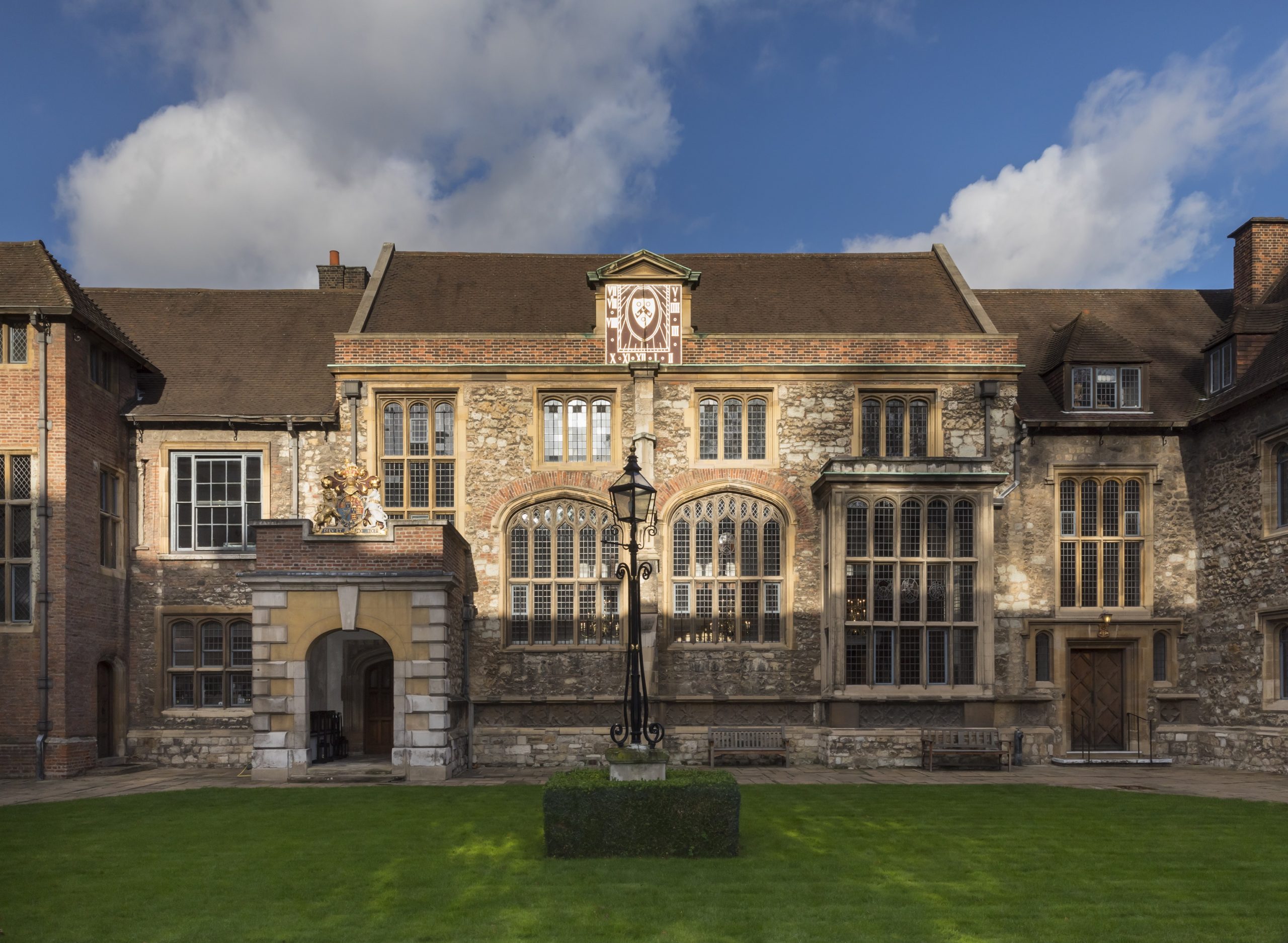
Charterhouse Master’s Court in EC1 (c) © Miko Malkowski the Charterhouse
Tidy flat
Now Mike finds that his ability to keep his home tidy means, “they bring prospective Brothers around the apartments with people who are reasonably tidy. Originally everyone had a one room bedsit, but thank goodness we now have separate sitting rooms. Our flats are lovely but have a very eccentric layout as much of the building is a Tudor, and part medieval because the monastery was here.
During lockdown the garden has been a lifesaver. We had people with Covid-19, three died, and we were asked not to leave for 4 months but the management was fantastic and none of the rest of us got Covid, simply due to the uber-careful management and that’s all down to the Master (who is a woman). We’ve also got a woman chaplain, both are absolutely lovely. We were all feeling it a bit and it would have been worse without the garden. I’d walk around the grounds three times a day and invent little pathways around by the bins to make it longer. We’re in 7 acres – but a lot of those acres have buildings on them. There are three main places you can walk, or around the periphery. In normal times the garden is open to the public and we have a garden evening and garden tours. We used to have two and a half gardeners, but now we’ve got one, and she does it brilliantly with some volunteers. I’m in charge of the peanut feeder and have just pushed the boat out and bought a coconut which the birds are feeding on quite well.
You can read about more people connected with the Charterhouse next interview (Feb 2021).
- Public tours are due to open at the beginning of May (do book), see https://thecharterhouse.org/visit-us/
- For a chance to live in the almshouses at the Charterhouse please contact Clerk to the Brothers, Hannah Crane. See all the information here, https://thecharterhouse.org/joining-the-community/almshouse/
Over to you
If you’d like to nominate someone to be interviewed who grew up, lives or works in Islington, or suggest yourself, please let me know, via nicolabaird dot green at gmail dot com. If you enjoyed this post you might like to look at the A-Z index, or search by interviewee’s roles or Meet Islingtonians to find friends, neighbours and inspiration. Thanks for stopping by. Nicola