Estimated reading time:17 minutes, 22 seconds
Everyone has a story. Shared Lives community worker Andy Harvey recalls stories about growing up in the 1970s around King’s Cross plus his thoughts about estates, the old Islington slums, hobbies and moving on. Interview by Nicola Baird.

These days Andy Harvey is often paddling on West Reservoir, a welcome new blue/green space in north London. He grew up in a much less car-orientated time around King’s Cross and says: “For years we didn’t have our own car, my dad worked for Fords during the week and he’d do private jobs at the weekend to earn extra money. So sometimes we’d be able to use that car for the rest of the weekend.” (c) NB for Islington Faces
Islington Faces met Andy Harvey, who is 60 in September, paddling at the Castle Canoe Club (that’s where we did the photo shoot too). He’s always witty on the water and often shares anecdotes about Islington life going right back. Turns out he grew up in Islington, although now he lives in Hornsey, just round the corner from the church where his parents, who are both from Barbados, first met.
FOLLOW ISLINGTON FACES a new interview is published every week.
“There’s a big old Bajan community in Hornsey, it was just one of those areas. A few people came, and then they said to friends ‘come and stay with us until you get established,’ but mum always liked Islington,” says Andy over a Zoom call.
“My mum was 22 when she came to London in 1956, My dad came in 1958. Both came independently of each other and planned to be here for a couple of years and then go back. Mum never went back, she’s 86 now and dad died years ago. They actually met in Hornsey, and lived in a shared house. My mum was telling my daughters that all the men lived upstairs, all the women downstairs. The women did the cooking, cleaning and ironing for the men, even though they didn’t know them! My mum said ‘I used to wash and iron your father’s white shirts because he was in the choir. I’d go and watch him sing, he had a beautiful voice.’ I said, ‘you were a groupie’ and mum didn’t know what I meant. My three daughters were killing themselves laughing.”
Playing out
Andy has very clear memories of moves when he was a small child. “The first house I remember living in until I was four years old was a big old Victorian house in Kings Crescent just down from Clissold Park. We had to move because they were knocking that house down to build the Kings Crescent estate, which they are now knocking that down – so it’s come full circle. I do remember a cooker on the landing and having to go outside to use the toilet. My mum didn’t like us using the bath indoors because the owner of the house had an Alsatian dog and used to wash the dog in the bath. My mum thought that was absolutely disgusting. I remember my younger brother by 18 months being washed in a tin bath or in the sink.
“One strong memory about Kings Crescent was there were no cars on the roads – maybe the odd one or two – but then every so often you’d look out and the road was jam-packed with cars and the sun would be bouncing off windscreens. Years later I realised that was when Arsenal was playing at home. We used to watch Saturday afternoon films – Cowboys and Indians or war films. I used to hear a siren from the house which was the factories in the area at knocking-off time, and lunch time and not air raid sirens as I feared!” he says laughing.
Moving to King’s Cross
“We were in a big shared house: four children in a two bedroom place. My parents had a bedroom and the other was shared between us, with kitchen on the landing. When my mum looked at places the council were offering, she saw a flat on the top (4th) floor of Bonnington House at the bottom of Caledonian Road, on Killick Street which had four bedrooms, but the main thing was she had her own front door –no one else could come in!” says Andy.
“There were 50 flats in the block and we knew everyone. We were the first black family to move in it was a real working class area. You had the Priory Green Estate on the other side of the school and that’s where majority of the kids from Winton primary school were from. At our estate it was mainly white English working class but also various with Irish descent. There was a family along the balcony from us who had 14 kids.
“We all played together and played football in the yard. Our next door neighbours were they had four boys of similar age to us, with Mark and Roy when we were quite young, seven, or eight or nine we’d go Red Bus Rovering all over London. My mum would say ‘Don’t leave the yard’, but straight away we were off going round London. We’d go to the British Museum, and all the museums down South Ken. I remember the 73 bus from King’s Cross went to Roehampton. One day we thought let’s see what’s there and we went all the way to the bus garage. We got a bag of chips and a can of coke, shared between the five of us and then went back on the bus to King’s Cross. It took all day! My mum said ‘what were you doing?’ We said ‘Playing football in the Stuart Mills,’ which had a green area in some nearby flats. We always had our stories straight,” he says.
In the front room
“The West Indian front room is important. Our house was meant to be four bedrooms, but one of the bedrooms was used as the best room. The kids weren’t allowed in there. It was only used when our parents had visitors, which wasn’t that often. It had a three-piece suite and a record player. Because my mum used to work during the day, and dad at night, there’d only be a couple of hours that we could sneak in there and play records. My parents didn’t drink but there would be a couple of bottles of rum or Scotch,” says Andy.
“My dad was a mason as well, so every so often they’d have some meetings at home. The reason my dad joined this Lodge was they’d put a tenth of their earnings into a pot and they bought a property for families from the West Indies so they had a place to live in until they got themselves established. They wanted my mum to join the woman’s lodge but she never got into it. Both my parents were religious. My grandmother on mum’s side was a Pentecostal minister.
“My dad would go out literally just once a month to his Lodge. There’d be a Christmas party every year and when I was much younger we’d have outings to the seaside – the Lodge would hire coaches. Can you imagine a 52-seater buses full of black families descending on Margate for the day all in our Sunday best?” asks Andy. Foolishly Islington Faces failed to follow up this question. But the general gist was Andy had a lot of fun on those big trips.
Playing out
“Mum was a cleaner working during the day. Dad was a mechanic and he would work nights. When we were really little, she was a machinist, then she worked for Nat West as a cleaner in one of their hostels near Bloomsbury for workers who moved to London before they established themselves and then later on worked as a lunch lady in the canteen until she retired. My mum didn’t like heights so didn’t work in Nat West’s tower block. She worked for Nat West for about 30 years.”
Back in the ’70s it was easier for children to earn a little bit of money by running errands. Andy says: “We didn’t get pocket money, but we all had our comics, that was the treat on the Saturday. We all had a comic each, mine was Whizzer & Chips. My sister had Mandy… Every so often we’d be given money for an ice cream and you’d use that for your Red Bus Rover. The neighbours’ boys would always be shouting up “Mum” give us a tanner and their parents would throw down sixpence for ice cream. Every so often we would do errands. You’d nip round and buy things for people from Mary and John who owned the grocer shop and maybe get some money or keep the change. When we got older we did car washing.”
People definitely kept an eye out for each other too. “My mum would go to Chapel Market and if she got a deal on oranges, she’d make me take them round to old people who lived in flats, and they’d give you some money as well. There was an old woman who lived on the first floor – you’d always wave at her and pop shopping in from time-to-time.”
Bonfires
“On Guy Fawkes day (November 5) we’d go to Highbury Fields and there’d be a huge bonfire, not so much fireworks but a bonfire and you’d have your toffee apple. Now bonfires are coming back, but there was a good 30-odd years when there weren’t any bonfires around London. We’d have our own bonfires locally and some people would go guying. We weren’t allowed to do that as our parents would say it was begging… but if we could, we’d try and get a place by the pub as a ‘penny for the guy’ was a good earner.
Bombs, squats and artists
“We used to play in the bombed ruins and the derelict houses. All of Barnsbury was squats growing up and people didn’t want to live there. If Islington council, or as it was then London County Council, hadn’t run out of money they’d have knocked down most of the houses in and around the Barnsbury area to clear the slums and build big council estates – that’s what they did at Priory Green estate and Packington. So they left them and then the squats and artists arrived. They always say ‘follow the artists’ – the same thing happened to Shoreditch. Artists move in, then the area became trendy, then it becomes expensive, then locals have to move out. Islington was like that. I think working class people didn’t really buy in the area, they were desperate to move out and they tended to move to Hertfordshire and Essex. Then people would move in. A lot of the Irish in the building trade would buy some of the big old houses and have lots of families renting their big houses – that generation is dying out now but some of them have got £2-3 million houses. They’d have the top and maybe rent out the bottom half,” observes Andy.
“We moved out of Bonnington House in the late 1970s because they were going to refurbish the estate [it was and is still there] – only five families were left when we moved out. Mum was really happy when we moved up to an actual house off Copenhagen Street near Crumbles Castle, and that’s where I lived until I left home when I was around 20 or 22. About 15 out of the 50 families moved to a newly built estate.”
Right schools
Then as now schools made all the difference. “My older brother went to a school called Philip Magnus which was just off Pentonville Road. My sister wanted to go to Starcross by Chapel Market (now Elizabeth Garret Anderson) but she didn’t get in. Then she had a couple of choices and they sent her to a school called Archway. When it was time for my choice I went to Archway too. It was hugely different although it was only three miles away. I think if maybe I’d stayed and gone to Philip Magnus, I may not be sitting here talking to you on Zoom as there was a lot of criminality in that area!”
See archive pix of Sir Philip Magnus here.
“There were fights that went on between the different estates – one group chasing another up the road. You were forever fighting. We just had to fight all the time. So actually leaving the King’s Cross area and going to Archway made me think I can actually get away from all of that and finish school. There was a lot of pressure to bunk off school and not go to school. The kids I grew up with at primary school in my flats – a lot didn’t finish school and left at 13 or 14 – they were bunking off all the time. But it was a school that didn’t do A levels so we then went to Islington sixth form centre, but we didn’t know what universities or colleges were,” he says – and this is the only time Andy looks saddened by his memories.
“My parents insisted we did well at school. Just like in Barbados, if you progressed in education, after 14, you had to pay for it. Mum was really proud that five out of her six kids had 100 per cent attendance. At one point some of the kids called me ‘the professor’ because I went to school!” says Andy.
=========================================
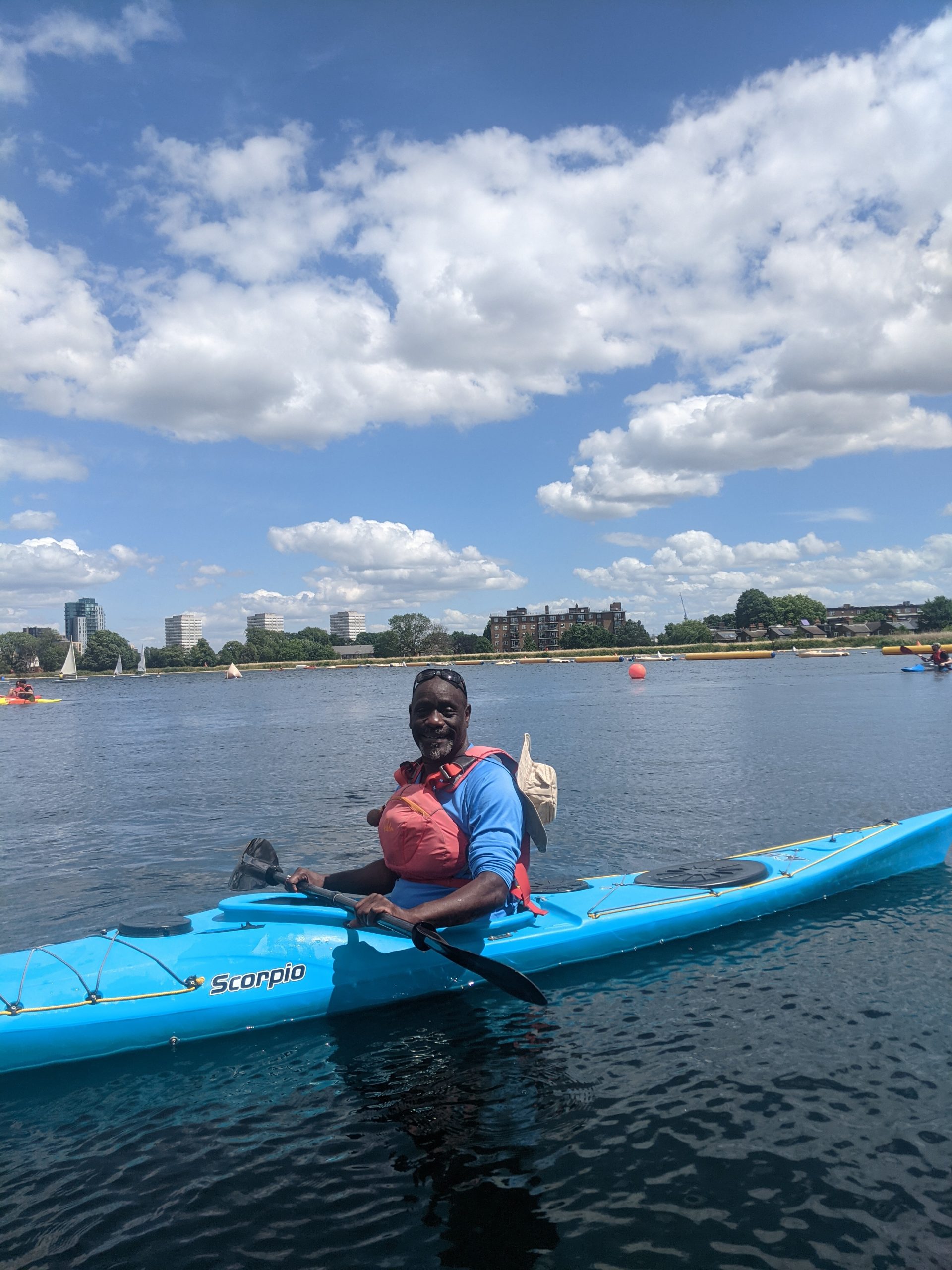
Andy Harvey: “I used to do a lot of clay sculpting. Two of my daughters did A level art, so that was always good sourcing materials for them and getting involved. I make little bits and pieces. I do like collecting things!”(c) NB for Islington Faces
Places Andy Harvey likes in Islington
- I remember the Castle Reservoir building being derelict when I was growing up. West Reservoir was shut off for years and years. If I passed it with my kids when they were young I’d say Rapunzel was up there and make stories up about it. Now it’s a brilliant climbing centre and I go to the Castle Canoe Club.
- I’m amazed by the way Upper Street has changed. Growing up there was nothing along Upper Street. 20 years ago (1990s-2000s) CHECK friends would say I’m coming to London shall we meet in town? I’d say where in Covent Garden – and they’d say no, Upper Street!. It’s still an absolute buzzing place.
- I love walking along Regent’s Canal. That was one of the things growing up that you couldn’t do – walk from King’s Cross to Camden Lock. They had barriers up along the towpath but every so often the corrugated iron had been knocked down and you could get further along to Camden Lock.
- I used to love Chapel Market. It was a really vibrant place. Feels a bit dead now. Talking to my sister we agreed that the market died when the guy stopped selling apple fritters. Maybe you wouldn’t get away with the health and safety now. If mum had enough money she’d buy us some apple fritters, that was a real treat. There was a guy with a budgie, a monkey and a parrot and you could have your picture taken with them sitting on your shoulder. The market went from Angel right to the other end and we always went on a Saturday. I think my mum used to use the shopping as a way of getting away from the kids. We could look out of our window and look right out to the top of Collier Street, past Priory Green estate and actually see if mum was coming down the road with the shopping bags. It was a treat to help her unpack the shopping.
===================================================
Growing up in King’s Cross
The old King’s Cross had quite a reputation, but it took a while for young Andy to pick up on this. “We used to go to a youth club at a church near Mount Pleasant and if you were 11 or 12 years of age it was up til 8pm. Older kids stayed til 10pm. My older sister was dropped home by the vicar’s son, and when the police saw her getting out of the car they stopped her and asked him how much she had charged. She would have been 14 or 15 at most. I just remember there was a knock on the door. I thought my sister was in trouble because she’d come home a bit late as there was a police officer asking my mum where she’d been. Then the police officer asked Michael, the vicar’s son, how much she charged him. My sister smacked the police officer around the face. Meanwhile my mum had a go at her, not for hitting the police officer, but just for being out! That was the first time I knew about prostitution around the area.”
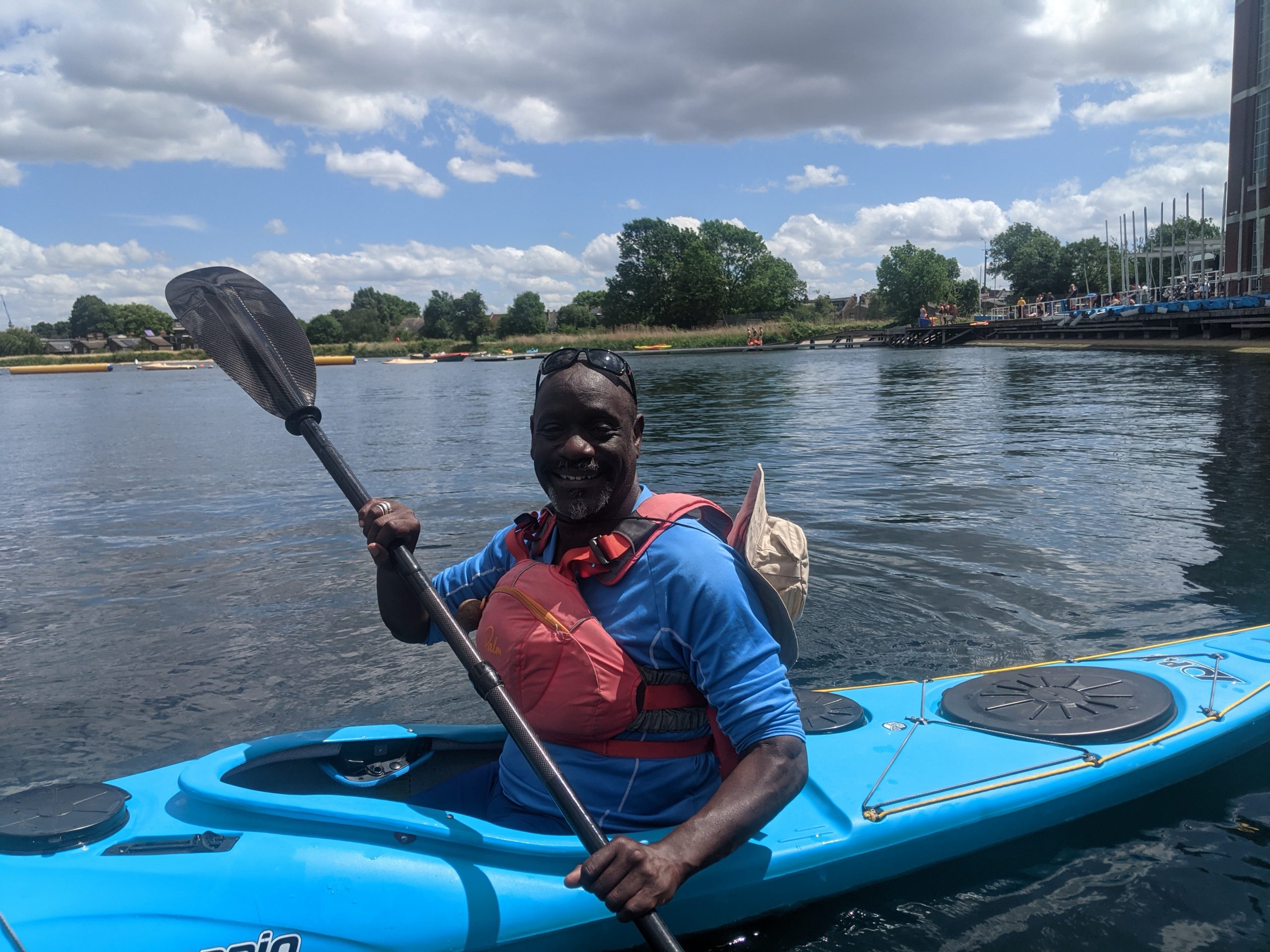
Andy Harvey often comes paddling with just the right hat, recent ones include a pride rainbow design and this broad brimmed explorer. Hats are not his only collection: “I just surround myself with stuff, because growing up we didn’t have much stuff.” (c) NB for Islington Faces
Civil service
Maybe his nickname of ‘The Professor’ was fortuitous. Andy says: “I ended up doing one A level, Geography, and a couple of extra O levels and leaving after sixth form and then I got a job in the civil service working on probate at Somerset House. I stayed there for five to six years. The work was dead boring, but I started to meet people from south London and the home counties, and do a bit of union work, and travel around country, and go to conferences and meet people involved in the miners’ strike. I’m still in touch with people I knew at the civil service. It was mind-numbing work, but lots of us were all the same age, and it was such a good laugh. These were the days you could go to the pub at lunchtime and back to work. There was even a bar in Somerset House.”
Life was giving him a good education: “In the 1980s there were a lot of train strikes – if there was a train strike you had to report to the local government building, but because I could walk to work because I lived at King’s Cross and then later at Euston (Somers Town), whereas everyone else was saying they were having to have days off, and then do overtime to clear up the back log of work!
“I’m very glad that I now have a much more interesting job and work for a local authority, Waltham Forest, for Shared Lives. We recruit carers to take vulnerable adults into their own homes, like an adult fostering service but without parental control. It’s mainly for people with learning disabilities, although some have mental health challenges and some are older people,” he explains.
And life has stayed very focused on north London.
“I’ve got three daughters – one lives in Stoke Newington working as a graphic designer; one in Finchley is a magazine production manager for Conde Nast magazines – Vogue and Traveller. My youngest daughter runs a dog-walking and dog-sitting company and has just qualified as a dog trainer. She’s always wanted to work with animals, and would go to Waltham Cross and walk retired greyhounds. I’m not a pet lover so I’m sure her mum said ‘when I leave your dad, we could get a couple of greyhounds’. And she did: she swapped me for two greyhounds!” jokes Andy. At least Islington Faces thinks it’s a joke…
Many thanks to Andy for sharing his Islington life. If you’ve got a story about growing up in Islington and you’d like it turned into an interview please contact Nicola, email: islingtonfaces@gmail.com
Over to you
Also if you’d like to nominate someone to be interviewed who grew up, lives or works in Islington, or suggest yourself, please let me know, via islingtonfaces@gmail.com If you enjoyed this post you might like to look at the A-Z index, or search by interviewee’s roles or Meet Islingtonians to find friends, neighbours and inspiration. Thanks for stopping by. Nicola